
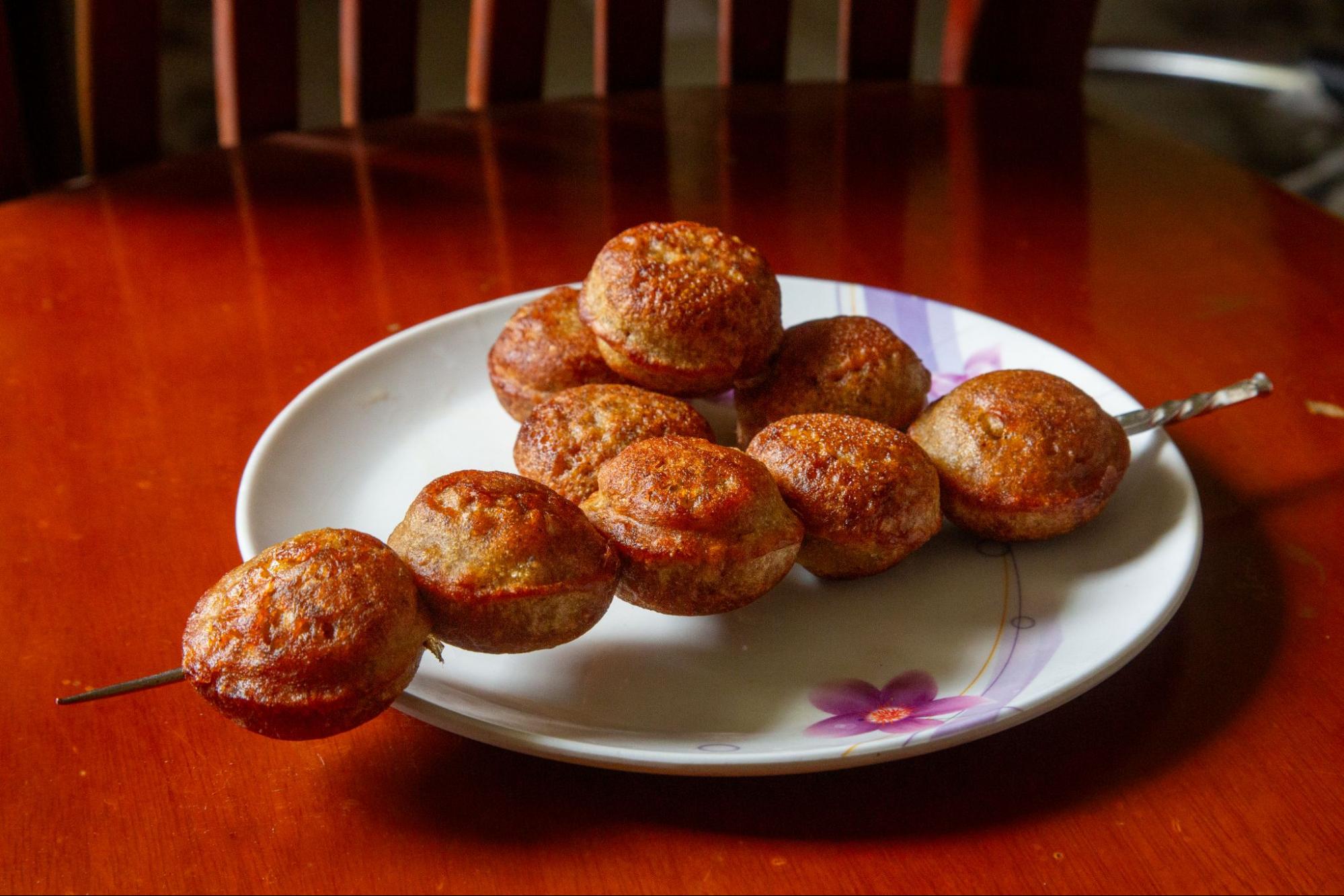
Karupatti paniyaram is a traditional Tamil sweet made from a fermented rice and urad dal batter sweetened with palm jaggery (karupatti).
In Tamil Nadu’s farming communities, the palmyra palm has long been part of both everyday cooking and special occasions. During the farming seasons, days are filled with long hours of hard labour. Palm leaves and shoots, fermented with millets, make kanji, a cooling porridge that sustains those working in the fields. Palm jaggery—produced by collecting the sweet sap (padhaneer) and boiling it down until it takes the shape of a solid block—has traditionally been used to make sweets and hearty snacks.
In this recipe, Akila Kunalan shares how to prepare paniyaram: soft and fluffy fermented rice-based balls sweetened using palm jaggery. Paniyaram can be savoury too, involving seasonal vegetables and tempering.
For the base batter
| Ponni parboiled rice | 1 cup |
|---|---|
| Raw Ponni rice | 1 cup |
| Whole or split urad dal, skinned | 2 tablespoons |
| Fenugreek seeds | ½ teaspoon |
| Water | 5 cups, to soak |
| Salt | 1 teaspoon |
| Water | 1 cup, to grind |
For the paniyaram
| Base batter | 2 cups |
|---|---|
| Palm jaggery, powdered | 80 grams |
| Water | 3 tablespoons |
| Ghee, for frying the coconut (optional) | 1 tablespoon |
| Fresh grated coconut (optional) | 55 grams |
| Dried ginger powder | ½ teaspoon |
For cooking
| Baking soda | ½ teaspoon |
|---|---|
| Neutral refined vegetable oil | Approx. 500–750 milliliters |
| (If deep-frying in a kadhai) | |
| Refined (untoasted) sesame oil | Approx. 5 tablespoons |
| (If using a paniyaram pan) |
What You Will Need
2 large lidded vessels, strainer, wet grinder or food processor, muslin cloth or cheesecloth, 1-2 heavy-bottomed pans, fine-mesh sieve, mixing bowl, paniyaram pan and lid (for the traditional cooking method) or deep kadhai and slotted spoon (if deep-frying the paniyaram), ladle
Instructions
For the base batter: Wash both types of rice separately, 3–4 times, or until the water runs almost clear and most of the excess starch has been removed. Wash the urad dal in the same way.
Add the washed and strained parboiled rice, raw rice, urad dal, and fenugreek seeds to a large vessel. Add approximately 5 cups of water, or enough to completely submerge the ingredients with about 2–3 cm of water above them.
Cover the mixture with a lid and leave to soak for at least 3 hours.
Once soaked, drain the water. Transfer the rice, urad dal, and fenugreek seeds to a wet grinder or food processor and add salt.
In a traditional wet grinder or a food processor, grind the mixture, adding 1 cup water gradually and only as required.The batter should be thick but pourable, falling slowly from a spoon or ladle, while retaining a slight graininess.
Transfer the batter to a clean vessel and cover loosely with a muslin cloth or cheesecloth. Leave to ferment for 6–8 hours, depending on the ambient temperature. If necessary, place the covered vessel inside a switched-off oven or in a warmer part of the kitchen. Once fermented, the batter should have visible air bubbles, feel fluffy and airy, and have a slightly tangy aroma. The batter will rise slightly but will not necessarily double in volume.
The base batter should yield about 4-4 ½ cups. Measure out 2 cups. Refrigerate the remaining batter for up to 3 days. Bring the refrigerated batter back to room temperature before using.
For the jaggery mixture: Place the palm jaggery and 3 tablespoons of water in a heavy-bottomed pan over low heat. Stir continuously until the jaggery has completely dissolved.
Remove from heat and strain the melted jaggery through a fine sieve to remove any impurities. Set aside to cool completely.
For frying the coconut: Heat 1 tablespoon of ghee in a heavy-bottomed pan over medium-low heat. Add the grated fresh coconut and fry, stirring continuously, until lightly golden and fragrant. Remove from heat and allow the fried coconut to cool completely. Skip this step if not using coconut.
For the final paniyaram batter: Place 2 cups of the base batter (at room temperature) in a mixing bowl.
Add the cooled palm jaggery syrup and dried ginger powder and mix thoroughly. If using the fried coconut, add it now and mix again.
The finished batter should remain thick enough to hold shape when ladled rather than spreading thin like a pancake or waffle batter.
For preparing the paniyaram, choose one of the following methods: (Traditional method: Using a paniyaram pan)
Heat a paniyaram pan over medium heat. Generously coat the pan with sesame oil, approximately ½ teaspoon per cavity.
Once the oil is hot (but not smoking), use a ladle to pour the batter into each cavity. Do not fill completely to the top, as the paniyaram will rise as it cooks.
Immediately cover the pan with a lid and cook for approximately 2 minutes, or until the bottoms are golden-brown and the paniyaram has puffed and rounded.
Carefully flip each paniyaram and cook uncovered for another 2–3 minutes, until evenly golden brown and cooked through.
Remove from the pan and serve warm.
(Alternative method: Deep-fried paniyaram): In a deep kadhai over medium heat, heat 500–750 ml vegetable oil (enough for the paniyaram to float).
Just before frying, mix ½ teaspoon baking soda into the batter.
Once the oil is hot (but not smoking), add small ladlefuls of batter into the kadhai. Be careful not to overcrowd the kadhai.
Fry until the paniyaram are golden-brown, then turn and fry until evenly coloured and cooked through.
Remove with a slotted spoon and drain on a plate lined with paper towel. Serve warm.
Tips
- The amount of palm jaggery can be adjusted according to the preferred level of sweetness. The quantity in this recipe produces a balanced, mildly sweet paniyaram. For sweeter paniyaram, increase the quantity of palm jaggery to 100 grams.
- The amount of water needed for grinding may vary. Add it gradually to make a soft, thick batter rather than a thin dosa-like consistency.
- The base batter should not be completely smooth; but its graininess should be subtle and slight. A batter that is too grainy could hamper the fermentation process.
- Fermentation time depends on ambient temperature. The batter may take longer than 6-8 hours to ferment in a cooler environment. Leave the batter to ferment until the batter is fluffy and air bubbles are visible.
- Strain the jaggery syrup before adding it to the batter. Palm jaggery can contain small impurities, even when it appears clean.
- Do not boil the jaggery syrup. It only needs to dissolve in the water; boiling will unnecessarily thicken the syrup and can alter the consistency of the batter. Cool the jaggery syrup completely before adding it to the batter. Adding hot syrup can affect the texture of the fermented batter.
- When using a paniyaram pan, grease the cavities generously with sesame oil. This is especially important because the palm jaggery makes the batter more likely to stick.
- If deep-frying the paniyaram in a kadhai, adding baking soda to the batter helps the paniyaram puff up and retain a rounded shape when deep-fried. Add the baking soda just before frying so the paniyaram remains light and rounded.
- Keep the heat moderate while cooking. Palm jaggery causes the paniyaram to brown quickly, so very high heat can result in a dark exterior while the centre remains undercooked.
Akila Kunalan is an IT professional whose passion lies in preserving south India’s rich agricultural heritage and traditional culinary arts. As a culinary researcher, her work focuses on unlocking the untapped gastronomic potential of the palmyra palm. To challenge public perception, she co-created an exhibition with palmyra tappers, showcasing 124 unique palm-based dishes. The exhibition was held at Panai Kanavu Thiruvizha, a two-day festival in Villupuram district, centred around the palmyra’s cultural importance.
This recipe has been published as a part of The Locavore’s collaboration with Powerhouse Museum, Australia. Titled ‘Setting The Table: Stories from India’s Food Cultures’, it aims to highlight diverse undertold stories about India’s culinary landscape to a non-native reader, adding texture to global narratives about Indian food.
Read more about the palmyra’s significance in Tamil Nadu here.
You must be logged in to rate this recipe.
 Login with Google

Sign in with email