

For Pragyan Sharma, nothing beats a bowl of tenga when the days turn unbearably hot. The sharp, sour notes of this signature Assamese dish are both cooling and comforting, and while most people associate it with summer, he doesn’t need the season or an occasion to enjoy it. For him, tenga is the ultimate comfort food.
In Assamese, the word ‘tenga’ simply means ‘sour,’ and it’s used to describe any dish built around tanginess. Among the many versions, the best known is Masor Tenga, a fish curry soured with lemon, tomato, or even elephant apple (ou tenga). But the one closest to Pragyan’s heart is Dhekia Paat Aru Aam Tenga.
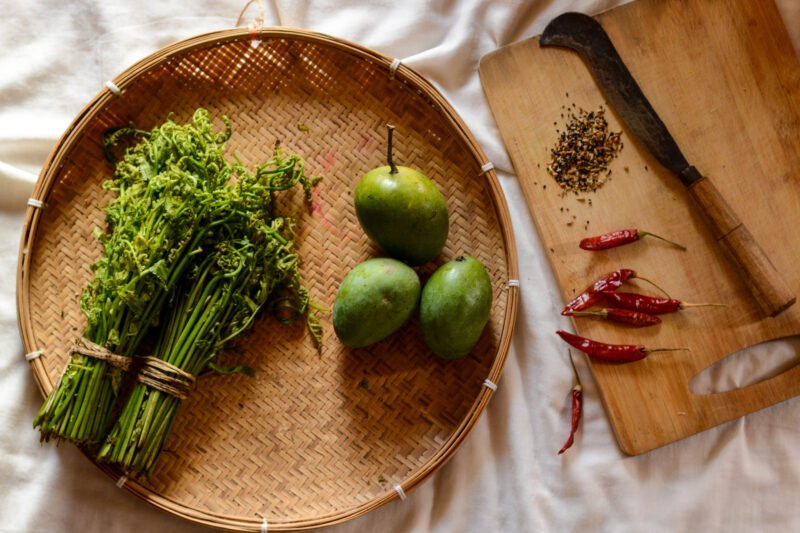
The dish brings together two ingredients. ‘Dhekia’ (fiddlehead fern), grows wild in the Himalayas, across the northeastern states of India, and in the Western Ghats. It must be handled with care—washed well in salt water to remove any grit, with the leaves separated from the coiled crosier and tender stalks. In this curry, only the leaves are used, while the other parts are often made into a simple stir-fry.
The sourness comes from raw mango, or ‘aam’ in Assamese, which balances beautifully with the earthiness of the fern. With just a handful of ingredients—dhekia, raw mango, panch phoron, and dried red chillies—the preparation is deceptively simple, yet layered and deeply satisfying.
| Red lentil (Masoor dal) | ½ cup |
|---|---|
| Turmeric powder | ¼ teaspoon |
| Salt | to taste |
| Water | as required |
| Mustard oil | 4 tablespoons (for frying) |
| Dhekia (fiddlehead fern) | 2 small bunches or 1 large bunch |
|---|---|
| Raw mango | 1 piece |
| Mustard oil | 1 tablespoon |
| Dried red chillies | 2 pieces |
| Panch phoron (East-Indian five spice mix: fenugreek, nigella, cumin, mustard, and fennel seeds | 1 teaspoon |
| Turmeric powder | ¼ teaspoon |
| Salt | to taste |
| Water | 2 ½ cups |
Heavy-bottomed cast-iron, steel, or aluminium kadhai; Mixing bowl; Slotted spoon; Knife or vegetable peeler; Paper towels
Soak the masoor dal for 2 hours, then wash and drain it. Transfer the dal to a mixer grinder, add turmeric and salt, and blend into a smooth batter. Add just enough water to help the mixture grind, keeping the batter thick.
The batter should not be runny but thick enough to hold its shape when dropped from a spoon. It shouldn’t be so stiff that it doesn’t spread at all.
Place a heavy-bottomed kadhai on medium heat and pour in mustard oil. Let it heat up until you see a faint shimmer on the surface.
Once the oil is hot, make the vadas by carefully dropping a spoonful of the batter into the hot oil. You can fry 3–4 vadas at a time, depending on the size of your kadhai. Do not overcrowd the pan.
Fry the vadas until they turn golden brown on all sides. Turn them occasionally using a slotted spoon so they cook evenly. This should take about 3–4 minutes.
Once golden and crisp, lift the vadas out with the slotted spoon and place them on a plate lined with paper towels to absorb excess oil. Keep them aside.
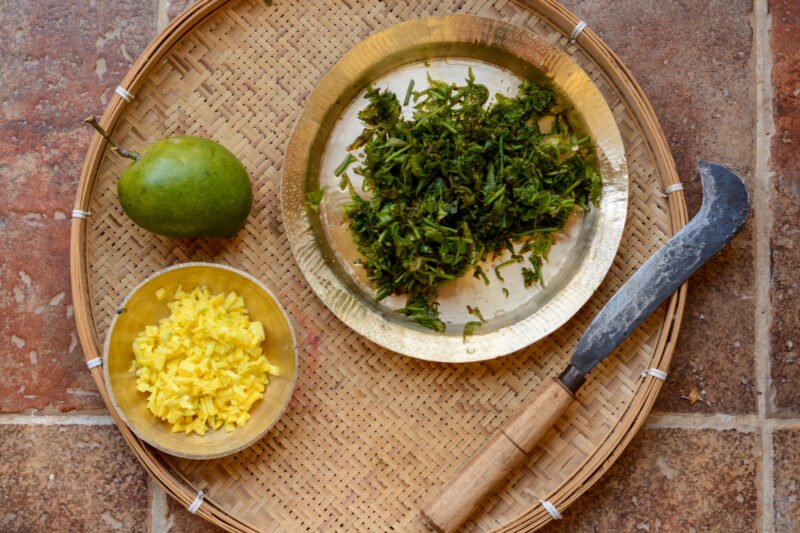
Next, take the dhekia (fiddlehead fern). Separate the leaves from the curled tops (crosiers) and stalks, keeping only the leafy parts.

Wash the leaves thoroughly in water mixed with a little salt. This helps remove any grit or tiny insects. Rinse at least 2–3 times until the water runs clear.
Drain the water completely and then chop the dhekia leaves roughly.
Peel the raw mango with a knife or a vegetable peeler. Chop it into small cubes (about 1-cm pieces).
Once you finish frying the vadas, carefully remove the excess oil from the kadhai. You can strain and keep it aside for later use, but for the curry you’ll only need about 1 tablespoon of fresh mustard oil. Return the kadhai to the stove, add 1 tablespoon mustard oil, and heat it for 10–15 seconds until slightly hot.
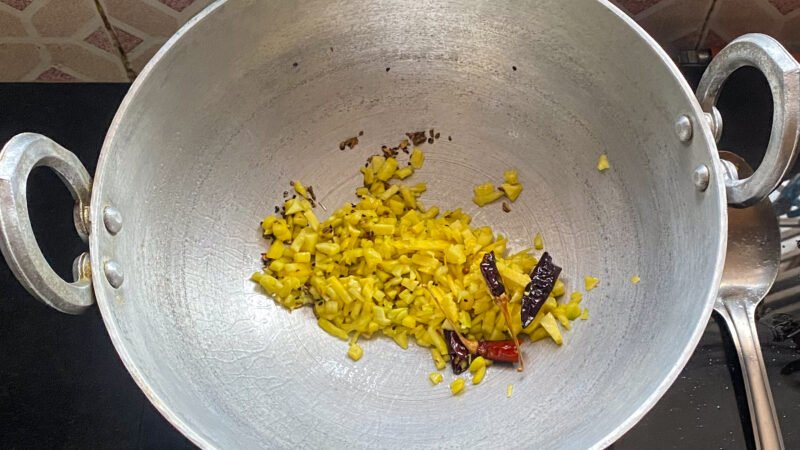
Break the dried red chillies into halves and add them to the hot oil.

Add the panch phoron, allowing the seeds to crackle for about 10–15 seconds. Be careful not to burn them—if they turn too dark, they will taste bitter.
Immediately add the chopped raw mango. Stir and cook for about 2 minutes until the pieces begin to soften.
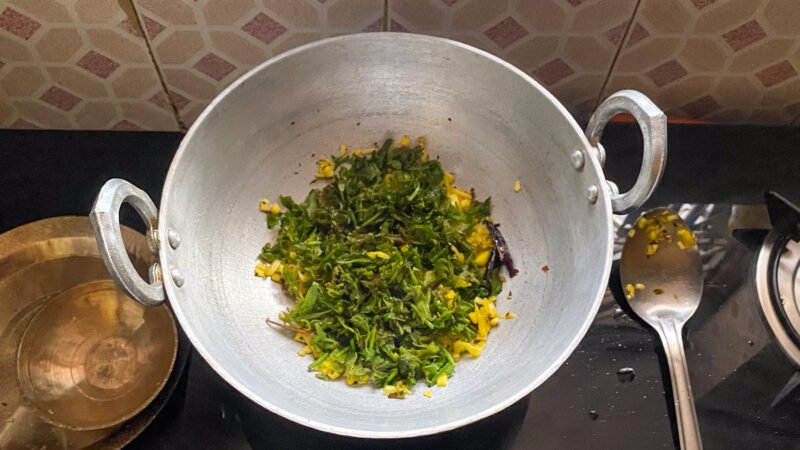
Add the chopped dhekia leaves, along with turmeric powder and salt. Stir well so the spices coat the leaves. Cook for about 3 minutes until the leaves shrink and release some water.
Pour in 2 ½ cups of water. Stir everything together and increase the heat to bring the mixture to a boil.
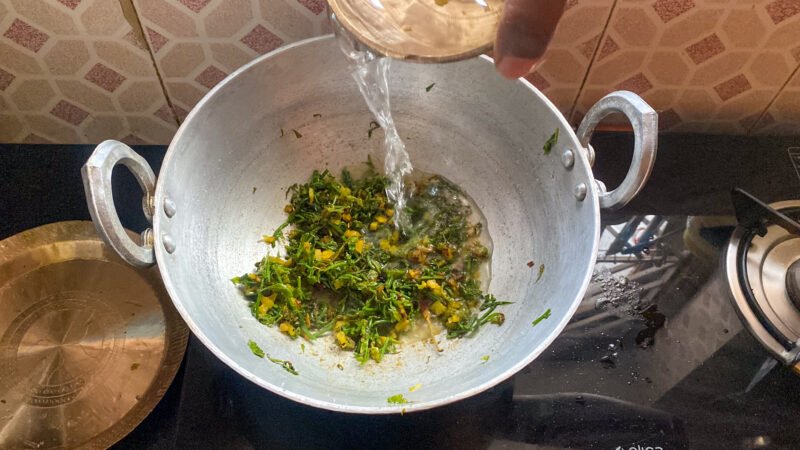
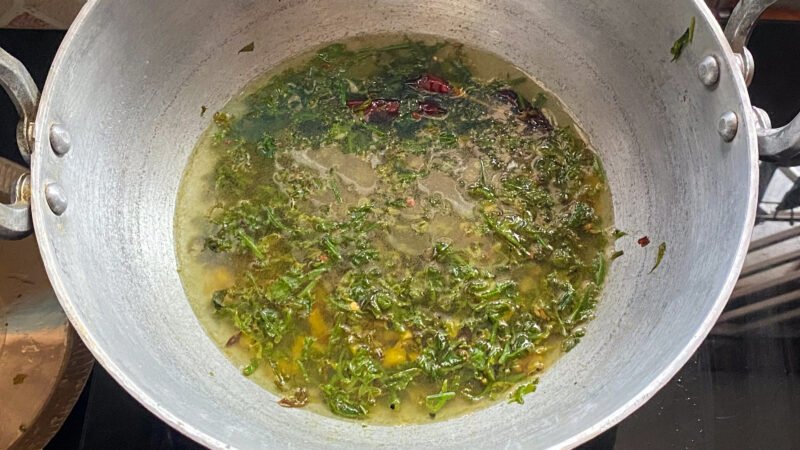
Once boiling, gently drop the fried vadas into the curry. Stir once to coat them in the liquid.
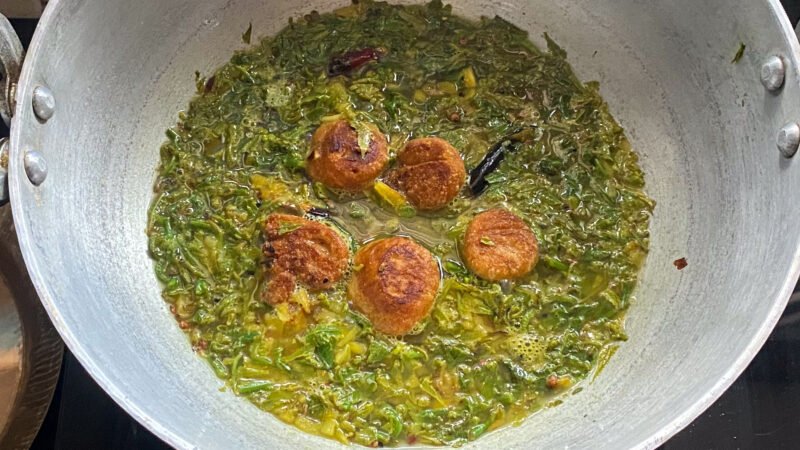
Cover the kadhai with a lid and reduce the heat to low. Let the curry simmer for about 5 minutes. During this time, the vadas will soak up some of the sour flavour of the mango, and the curry will reduce slightly.
After 5 minutes, uncover and taste the curry. Adjust salt if needed. The flavour should be slightly tangy from the mango and earthy from the dhekia.
Turn off the heat. Serve hot with plain steamed white rice.
Pragyan Sharma ( @sarparag) is a fashion photographer and a wildlife visual artist based in Bengaluru. Originally from Assam, he is passionate about baking, exploring global cuisines, and sharing the rich tapestry of Assamese food and culture. He is also a member of The Locavore’s Local Food Club in Bangalore. To become a member, sign up here.
You must be logged in to rate this recipe.

 Login with Google