
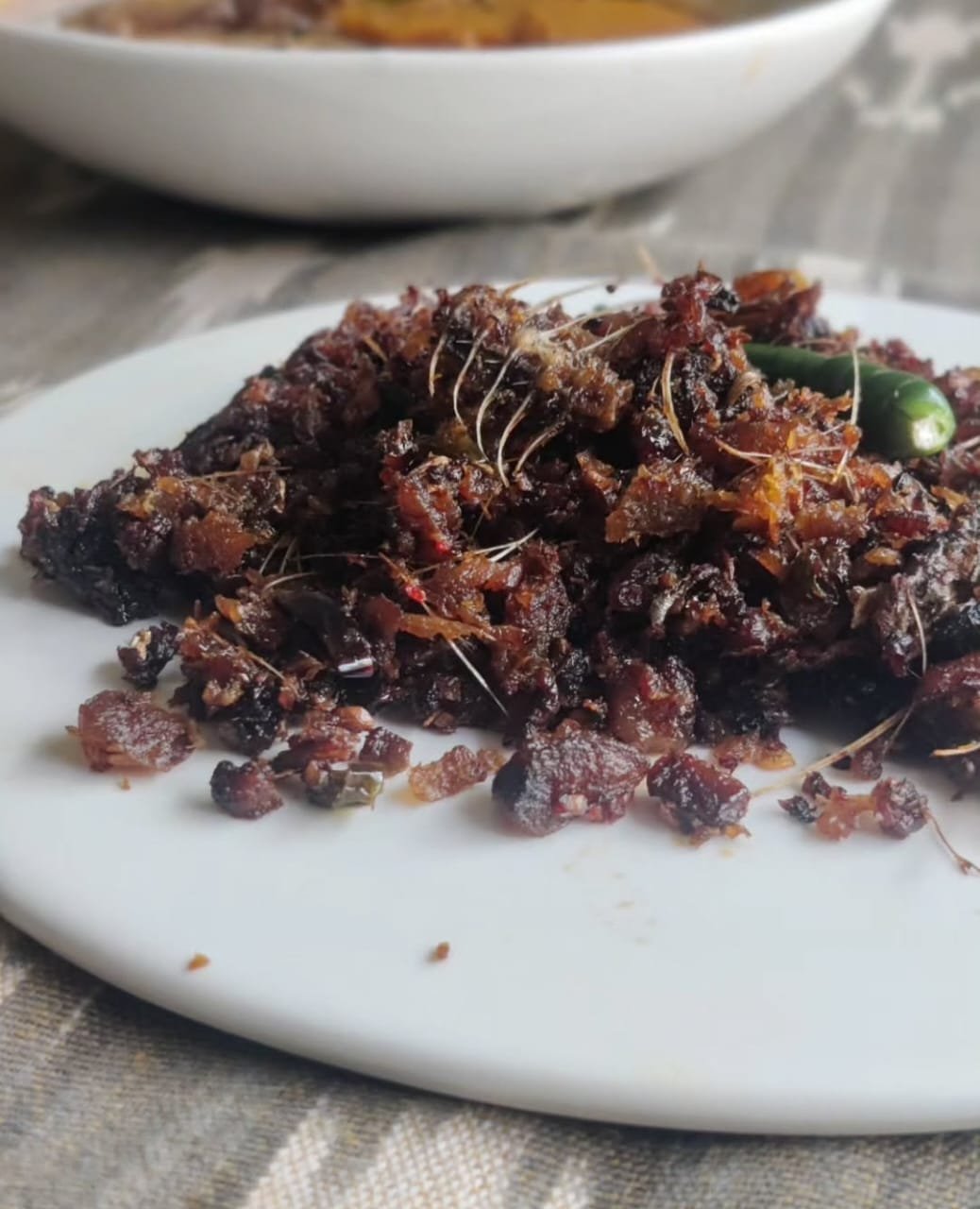
Ghaittya is a traditional dish from Chittagong, made from shredded Hilsa fish. It is believed that when Hilsa was abundant during the monsoons, households often received more than they could consume. Without refrigeration, some of the fish would begin to spoil. Instead of discarding it, cooks would transform it into a flavourful dish by frying it with garlic and onions until it fell apart. The pungency of garlic combined with the crispness of fried fish masked any overpowering odours. Over time, families began adding green chillies, red chilli powder, and cumin powder to lend more flavour.
The dish is also a reflection of a broader practice—making the most of what’s available. For many, including Moumita Mukherjee’s family, this wasn’t just about thrift but a way of life shaped by necessity and care.
Moumita first encountered Ghaittya about 15 years ago, soon after her marriage. Having grown up in Bengal, her experience with Hilsa was mostly through classic preparations like Ilish Bhaja and Ilish Bhapa. In contrast, she found Chittagong’s food to be distinct, marked by new flavours, the generous use of garlic, and a fondness for dried fish. It was her cousin sister-in-law Himani, a native of Chittagong, who introduced her to Ghaittya.
| Hilsa (cut into steaks) | 3 pieces |
|---|---|
| Turmeric powder (total quantity) | ½ teaspoon (¼ tsp for marination + ¼ tsp for the spice paste) |
| Salt | a pinch / to taste |
| Mustard oil | 3 tablespoons |
| Garlic cloves (roughly smashed) | 10 |
| Panch phoron (five-spice mix) | ½ teaspoon |
| Onion (thinly sliced) | 1 cup |
| Green chillies (chopped) | 3 pieces |
| Coriander powder | ½ teaspoon |
| Cumin powder | 1 teaspoon |
| Chilli powder | ½ teaspoon |
| Water | 2 tablespoons approx. |
| Fresh coriander (chopped) | 2 teaspoons |
Kadhai / heavy-bottomed wok; Small mixing bowl; Flat spatula; Tongs or long-handled spoon (for turning the fish); Kitchen paper
Pat the Hilsa steaks dry with kitchen paper. Rub them lightly with ¼ tsp turmeric powder and salt. Let them sit for 10-15 minutes.
Heat mustard oil in a kadhai over medium–high heat until it begins to glisten.
Shallow-fry the marinated Hilsa steaks in the hot oil for 2-4 minutes on each side, depending on the thickness of the fish, until the surface is light golden. Fry in a single layer; don’t overcrowd the wok. Transfer the fried steaks to a plate and set aside. (Leave the flavoured oil in the wok.)
Reduce heat to medium. Add the smashed garlic to the same oil and fry, stirring, until the garlic turns light golden and fragrant. This should take about 30-40 seconds.
Add the panch phoron and sauté briefly until it begins to splutter.
Add the sliced onion and cook, stirring frequently, until the onion is soft and translucent. Add the chopped green chillies and sauté for 30 seconds more.
Return the fried Hilsa to the wok. Using the back of a spatula, gently begin to break the steaks into large flakes. Carefully break the Hilsa into pieces; do not puree. Mix it well so the fish soaks up the tempered oil and onions.
In a small mixing bowl, combine the powdered spices (the remaining turmeric powder along with coriander powder, cumin powder, chilli powder) with about 2 tablespoons of water to make a loose, lump-free paste.
Add this spice paste to the wok and keep the heat at medium–high. Stir and fry the mixture, breaking the fish further as you go, until the smell of the raw spice disappears and the masala has integrated well. This should take about 3-5 minutes. The mixture should reduce slightly but remain moist.
When the fish and masala are well combined and beginning to get a little crisp at the edges, stir in the chopped coriander and fry for another 30 seconds. Check the seasoning and adjust salt, if needed.
Remove from heat and serve hot.
Hilsa is an oily and fragile fish; handle gently while frying and while breaking into flakes. Use the flat edge of a spatula and gentle downward pressure.
An IT professional by trade, Moumita Mukherjee finds her true passion in cooking and exploring recipes—especially from Bangladesh and regions of West Bengal. As a home chef, she experiments with new flavours and ingredients. She is also a member of The Locavore’s Local Food Club in Kolkata. To become a member, sign up here.
You must be logged in to rate this recipe.

 Login with Google