

In Geetha Venkataraman’s home, celebrations for Pongal began a day earlier with ‘Bhogi’, which she describes as “the ‘out with the old, in with the new’ festival.” After dark, a bonfire would be lit, into which old clothes and unused household items were thrown. This act coincided with the start of a new month in the lunar calendar and the harvest season. While poli—a sweet flatbread—-is traditionally prepared on Bhogi, it wasn’t made in her household. What she does remember are the bonfires in Chennai, experienced with her cousins.
The morning of Pongal followed a fixed sequence. Oil baths were taken early, new clothes were worn, and offerings were prepared for Surya, the sun god. These included chakkarai pongal (sweet pongal), ven pongal (savoury pongal), and vadai. “In villages, the sweet pongal would be cooked in an earthen pot over fire,” Geetha shares. In her home, it was initially cooked in a bronze vengala panai, which was anointed with turmeric and kumkum, with turmeric plants tied around its rim.
As a child, Geetha admits she found both sweet and savoury pongal rather mundane. “They were both made of rice,” she says, “and crisp vadais were far more exciting.” Over time, however, her relationship with the dish changed. Today, ven pongal—especially with fresh coconut chutney or sambar—is what she deeply enjoys.
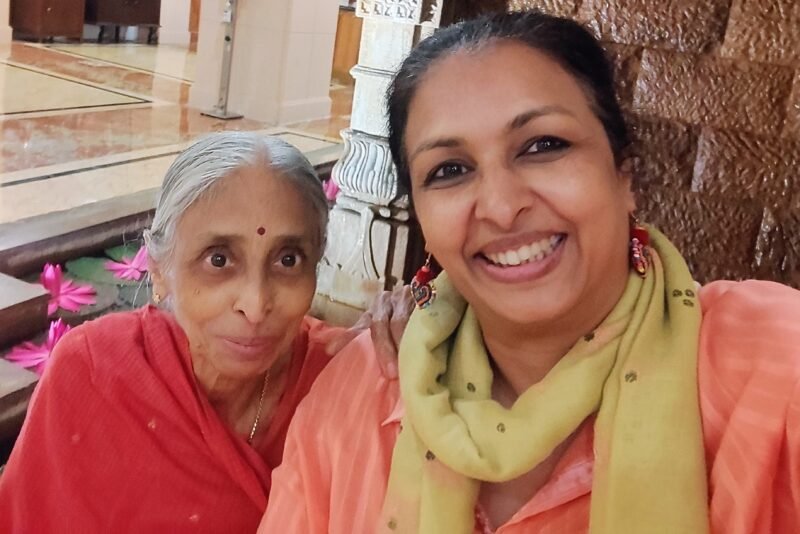
Caption: Geetha with her mother Visalakshi.
For the pongal:
| Raw rice | 1 cup |
|---|---|
| Yellow moong dal (split, skinless) | ⅓ – ½ cup |
For the spice mix:
| Ghee | 1 tablespoon |
|---|---|
| Cumin seeds | ½ teaspoon |
| Black peppercorns | 1 teaspoon |
| Ginger, finely chopped | 1 teaspoon |
| Curry leaves | 4–5 |
| Salt | to taste |
| Hing (asafoetida) | a small pinch |
| Water | 5 cups |
For the tempering:
| Ghee | 1 tablespoon |
|---|---|
| Cashews, halves | 8–10 |
What You Will Need
Heavy-bottomed pan; pressure cooker; small frying pan or tempering pan; mortar and pestle or spice grinder; ladle or masher
Instructions
Place the raw rice in a heavy-bottomed pan and dry-roast it over a low heat. Stir continuously so it heats evenly. The rice should smell lightly nutty but must not change colour. Transfer to a bowl.
In the same pan, dry-roast the moong dal on low heat, stirring constantly, until it becomes lightly aromatic. Do not allow it to brown. Remove from the heat and allow both the rice and dal to cool slightly.
Once cooled, combine the rice and moong dal in a bowl. Rinse them together under running water, rubbing gently between your fingers, until the water runs clear. Drain well.
Heat 1 teaspoon of ghee in a small pan on low heat. Add the cumin seeds and black peppercorns. Stir gently and roast just until fragrant; this should take 30–40 seconds. Switch off the heat immediately to prevent burning.
Allow the spices to cool slightly, then coarsely crush 1/2 of the spice mix using a mortar and pestle or a spice grinder, the rest are added whole. The texture should be coarse, not a fine powder.
Transfer the washed rice and dal to a pressure cooker. Add half of the crushed spice mix, the remaining whole roasted whole spices, the chopped ginger, curry leaves, salt to taste, and a small pinch of hing. Pour in the measured water and stir once to combine.
Close the pressure cooker securely and cook on medium heat for 5–6 whistles (approximately 15 minutes). Once done, turn off the heat and allow the pressure to release naturally. Do not force open the cooker.
When the pressure has fully released and the cooker is safe to open, remove the lid. Using a ladle or masher, gently mash the pongal until it becomes soft, creamy, and porridge-like in consistency. If it feels too thick, you may add a small splash of hot water and mix well.
Heat 1 tablespoon of ghee in a small pan over medium heat. Add the halved cashews and fry until golden and crisp. Pour the hot ghee-and-cashew mixture over the pongal. Serve hot.
Tips:
Pongal thickens as it cools; if serving later, loosen its consistency with a little hot water and adjust salt if needed.
Dr. Geetha Venkataraman (veegeetha) is a professor of mathematics at Dr. B.R. Ambedkar University, New Delhi. She is a keen bird-watcher and enjoys photographing them. Her mother, Visalakshi Venkataraman, is a retired teacher; she loves gardening and trying out new recipes.
You must be logged in to rate this recipe.
 Login with Google
Sign in with email