
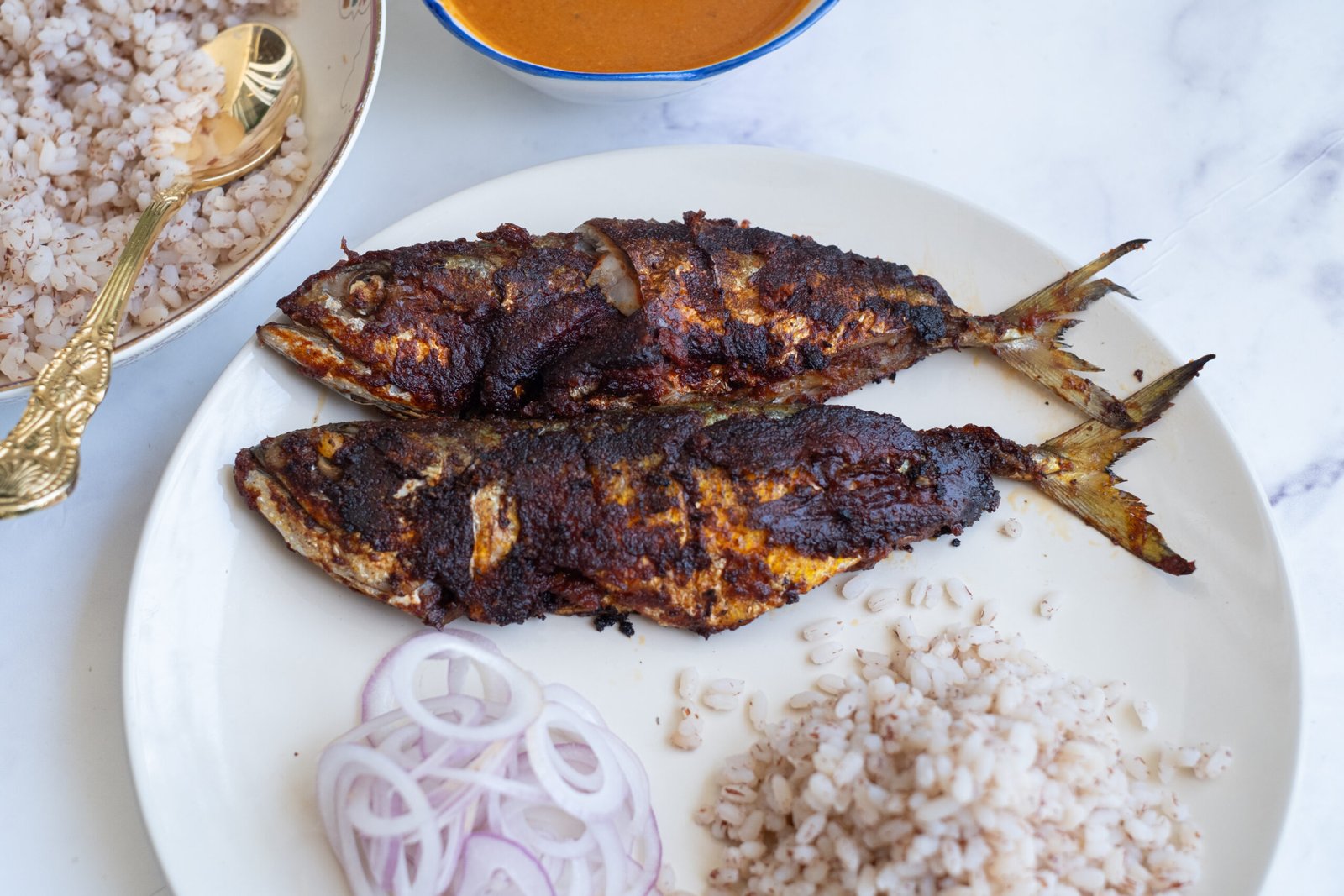
My introduction to Recheado has unfolded slowly over two decades of travelling through Goa. My earliest Chef on the Road trips in the state go back almost 20 years. Cooking with home cooks, eating in small taverns, and tasting countless local versions, I’ve come to understand and deeply respect the diversity and nuance of Goan cuisine. One of the dishes that stayed with me from the beginning was Bangda Recheado—simple in form, but layered with history, memory, and technique.
‘Recheado’ comes from the Portuguese word ‘recheado’ (to stuff) referring to the way mackerel is slit and packed generously with a vivid red chilli paste unique to most Goan Catholic homes. Every family guards its own recipe, but the foundation rarely changes: Byadgi chillies for colour, a hotter variety for heat, Goan palm vinegar for sharpness, tamarind for rounded sourness, and a handful of warm spices.
Unlike restaurant adaptations, the traditional Recheado masala is never cooked directly. It is stone-ground raw into a thick, pungent paste that clings to the fish inside and out. When the stuffed mackerel is shallow-fried in coconut oil, the masala chars just enough while the fish steams and crisps. Served alongside rice, fish curry, or sannas, it’s a perfect example of how coastal Goan food balances fire, acidity, and depth with effortless confidence.
This version stays faithful to the Goan Catholic home-style method, preserving the deep maroon colour, bright acidity, and fiery warmth that define true Recheado.
For the Recheado Masala
| Byadgi red chillies (for colour) | 12-14 |
|---|---|
| Guntur/Sannam chillies (for heat) | 6-8 |
| Tamarind | 2 tablespoons |
| Garlic cloves | 12-15 |
| Ginger | a ½ -1 inch piece |
| Cloves | 6-8 |
| Peppercorns | ½ teaspoon |
| Cumin | ½ teaspoon |
| Cinnamon | ¼ inch |
| Salt | 1-1 ½ teaspoon |
| Sugar | ½ -1 teaspoon |
| Goan palm vinegar (toddy vinegar preferred) | 3-4 tablespoons |
| Water | as needed |
For the Fish:
| Mackerel (bangda) | 4, medium |
|---|---|
| Salt | as needed |
| Coconut oil | for shallow-frying |
What You Will Need
Mixing bowl; blender or stone grinder (vaan); sharp knife for slitting fish; wide pan for shallow-frying pan or cast-iron tawa
Instructions
Snip the chillies into pieces and remove the stems. Soak them in warm water for 15–20 minutes until softened. (This helps achieve a smoother, deeper-coloured paste.)
Soak the tamarind in warm water for 10 minutes. Squeeze to extract a thick pulp and strain. Set this aside.
In a grinder, add the soaked chillies, garlic, ginger, cloves, peppercorns, cumin, cinnamon, salt, and sugar. Add the tamarind pulp and spoon by spoon add the Goan vinegar.
Grind to a thick, smooth, deep red paste. Add a splash of water only if needed to help grinding. The paste should be fiery red, glossy, and thick enough to hold in the slits of the fish. In terms of flavour, it should be hot, tangy, and slightly sweet.
Rinse and pat dry the fish. Using a sharp knife, make a deep slit along each side of the mackerel without cutting through. Sprinkle lightly with salt.
Fill each slit generously with the Recheado masala.
Spread more masala over the outside of the fish until it is fully coated.
Rest for 30–45 minutes to allow the flavours to penetrate.
Heat coconut oil in a frying pan over medium heat. Place the marinated mackerels gently on the pan.
Shallow-fry for 4–5 minutes on each side, until the masala darkens and the fish crisps at the edges.
Avoid high heat. The paste should char lightly, not burn. Rest for 2 minutes before serving.
Tips:
- Toddy vinegar lends the most authentic flavour; white vinegar works too, but is sharper.
- Avoid over-watering the masala. It must remain thick to stay inside the fish.
- Use a wide spatula when turning the fish to prevent breaking.
- A combination of Byadgi and Guntur chillies gives the most traditional balance of colour and heat.
- The masala can be made in advance and kept refrigerated for 3–6 months in a sterilised jar.
Thomas, known widely as ChefTZac, is a chef, storyteller, and food systems advocate with nearly 15 years of professional cooking experience. After training at the Culinary Institute of America and working at Le Bernardin in New York City, he returned to India to explore the depth of regional cuisines, later helming the kitchen at The Bombay Canteen as Chef Partner.
In 2022, he founded The Locavore, a platform dedicated to Doing Good Through Food by championing local ingredients, producer communities, and culturally rooted knowledge systems. His work now sits at the intersection of food, memory, sustainability, and community—shaped by years of travelling across India to learn directly from home cooks, farmers, and indigenous communities.
You must be logged in to rate this recipe.
 Login with Google
Sign in with email