Goa’s food and beverage industry shimmers with innovation, despite its fertile foodscapes facing threat. What role do chefs play in resolving this dichotomy?
Goa is in the midst of a culinary renaissance. This summer, the grounds along the river Mandovi in the capital city of Panaji were booked for food and culture festivals that spotlighted seasonal produce such as cashews and mangoes, and brought together music performances, local vendors, and produce from farmers’ markets. Around the same time, Wild Otters Research, a conservation-based research organisation, teamed up with the brewery Great State Aleworks to create an innovative seaweed sour beer called ‘The Ridley’. Part of the proceeds from the beer sales went toward research in conservation of Olive Ridley turtles in Goa. Every winter since 2022, around 100 people, many of them tourists, gather for Feast in the Fields—a Goan dining experience held in a rice field by local chef Ralph Prazeres—complete with Indo-Portuguese fare and feni cocktails.
This fever pitch in Goa’s culinary renewal and experimentation has been growing since the Covid-19 pandemic. When most state borders closed, Goa remained open to domestic tourism. Urban Indians—drawn in by azure waters, green rice fields, reasonable rents, and the digital nomad culture—saw Goa as the promised land. Chefs from cities like Delhi and Mumbai launched outposts in Goa and worked with seasonal menus, while young Goans opened restaurants in their gardens, serving up childhood lunches with the spirit of transatlantic travel. Even in the small village where I live, the shed that served rice-and-fish meals came to share its balcony with a new coffee shop where one could order matcha, or coffee with black sesame—if you could afford it.
But this crest of creativity is not without its downsides. Century-old Goan Portuguese homes are increasingly being snapped up and transformed into exclusive restaurants and membership-only clubs. More significantly, the landscape itself has begun to shift. The hills that border the islands of Goa have been carved out for large villa projects and bungalows with paved driveways. Liana-threaded walls of homes across villages disappear behind blue corrugated metal sheets, only to reveal high-gated hotels some time later.
In light of such encroachment, February 2026 saw residents of Goa marching towards Panaji, chanting ‘Do or Die’. With women at the helm, citizens were protesting against the controversial 39A amendment to the Town and Country Planning Act. The amendment allows environmentally sensitive zones and cultivable land to be converted into settlement areas open to commercial development, without transparent mechanisms involving the public. The act also targets orchards and farms under active cultivation.
These rapid changes come as an existential threat to Goans who depend on these lands for sustenance. Over centuries, reclaimed lands along the backwaters have been transformed into an interlaced system of rice fields, aquaculture ponds, and salt pans. During monsoons, this land serves as natural flood control infrastructure, storing excess water and recharging aquifers. Community-built sluice gates that regulate the water between river and sea maintain salinity in the fields, allowing salt-tolerant rice varieties to thrive and fish to breed. These liminal spaces are also centres for ritual and ceremony, where children are taught how to hold a bamboo fishing pole and identify which fish is to be eaten in which season.

With Goa’s landscape, and the ecocultural heritage of reciprocity between the land and people under attack, certain chefs and restaurants have found themselves at a reckoning. When it comes to protecting the local land and waters, what is their responsibility?
A movement to recognise Goa’s commons
Chef Sai Sabnis recalls that she never worried about having enough to eat during the pandemic. “I knew where the cashew, jackfruit, and bimbli trees were. There are always fresh greens around, and people around me have started growing vegetables in their gardens. Goa is a landscape of abundance if you know what to eat. And if you are willing to eat it.” As a chef working at the intersection of food as art, ecology, and nourishment, Sai centres local food systems through her initiative Posa Mindful Gastronomy, which hosts private meals and offers a subscription service for salads and smoothies made from locally sourced and native foods.
Working out of a meticulously organised kitchen in Assagaon, Sai gravitates toward ingredients that are plenty and season-specific: wild pepper elder from in-home gardens, or jackfruits freely given by neighbours in late summer. Even in times of abundance, nothing goes to waste. Ingredients that are in season are preserved through fermentation or pickling. The seaweed I collected for her is quickly dropped into a colander to be frozen for later.
Sai is also a regular at Mapusa Market, where indigenous, local foods are available alongside wholesale produce. As she walks through the market, she chats with women farmer-vendors about growing and preparing okra and pumpkins. “This market is an irreplaceable inspiration… and it will continue only as long as buyers make it worth their while,” Sai says.


When she gifted me one of her salad boxes, it was like a walk through the fields and the market she frequents. Small snake gourds were flash-fried, while red amaranth, pepper elder, and lablab beans were marinated in sweet-and-sour Totapuri mangoes. The crunch came through with local cucumbers and pumpkin seeds tossed in a vivid purple dressing made using jamun.
As I bid goodnight to Sai and her dog, Penny, she hands me a sticker lying on the table by the door: “Amka Naka 39A” (We don’t want 39A). A main demand of the movement is to recognise Goa’s commons, which are threatened by decisions under the 39A amendment. “We need to say that we are not okay with what is happening to Goa right now. We are all responsible for this,” Sai asserts. She’s right; with continued resistance, the voices of the people were strong enough to move the act for review in the legislature. It has now grown into a citizens’ movement demanding the complete removal of the act.
“[With this threat to] Goa’s ecology and food security, it feels urgent to eat and share the gifts of this land, to strengthen our connection back to it and the people that nurture it,” Sai shares. “[My kitchen highlights] not just local and seasonal, but foraged, indigenous, and ecologically important foods too. For example, rice varieties that can grow in saline marshes, or drought-tolerant wild greens and fruit are key to our future sovereignty and survival—they are natural resources that we cannot lose sight of.” In this spirit, Posa Mindful Gastronomy organised a fundraiser dinner for the Goa Foundation, one of the longest surviving action groups working to protect Goa’s natural environment, with the entire proceeds going toward the Foundation’s conservation efforts.
Rice varieties that can grow in saline marshes, or drought-tolerant wild greens and fruit are key to our future sovereignty and survival—they are natural resources that we cannot lose sight of.
As Sai rightly identifies, food sovereignty is closely tied to land sovereignty. In Goa, place names reflect the foods that grow there—Aldona, for example, is said to be named after halad (turmeric), which grows in the village in abundance. By working with local ingredients, chefs like Sai build relationships with the people growing food. But how does this industry—which relies on the knowledge and labour of food-producing communities—ensure that these communities are supported, and that their right to land is not culled?


Chef Madhav Dayal is invested in answering this question through practice. I catch Madhav after weeks of trying to schedule a call with him. He’s just returned from work, but his voice is warm as he gushes over the profile picture of my cats (“I am totally a cat person!”). After spending many years in the kitchen, Madhav has started working with local farmers, fisherfolk, artisans, and small producers through his new initiative, Folk Labs. By understanding how food growers sow, rear, and harvest produce—and practising with them—Folk Labs hopes to build a model that encourages the culinary industry to move away mass-produced ingredients that are erased of their contexts.
When I ask Madhav what role the industry plays in protecting Goa’s commons, he tells me, “Chefs can be the ambassadors for ingredients, but we also have a responsibility to work with the farmers, those who grow the ingredients.” One way in which Folk Labs does this is by documenting the stories of the people behind the food. Madhav asks, “Do you know Surya from Galgibag? He forages for the best oysters to serve at his shack. There are so many locals who are passionate about their produce. We need to support them and tell their stories.”
Madhav carries the hope that “by creating a partnership instead of a transaction, farmers become collaborators in the creative process, and chefs become invested in preserving local agriculture. If we can reconnect traditional systems with contemporary kitchens, while supporting the people who preserve them, we can build a stronger and more sustainable foundation for Indian cuisine.”
Beyond produce, process too must be local
Ethical sourcing, however, is only one part of the answer. Working with local ingredients requires one to rethink their menu, invest in research and recipe development, and employ local and knowledgeable staff.
An example of this investment is seen in the kitchen collective (TKC), a women-led restaurant and training centre, founded by social entrepreneurs Solomon Premnath and Sandra Rothboeck. They do this through a combination of practical kitchen training, English-language classes, and creche services for children of the staff. The long-term goal is for their trainees to launch their own offshoots and share the profits.
From the outset, Solomon wanted to focus on the culinary traditions from the western coast of India, a region he calls home. TKC’s summer offerings—which featured crumb-fried breadfruit, grown in the restaurant garden and various mango-based dishes—showcased the significance of adapting menus to seasonal availability. The breadfruit was served with gudamba, a jaggery-sweetened mango chutney based on a trainee’s family recipe. “This programme is meant to create a sense of agency, a path of learning and innovation. The food is not separate from the people; it is deeply cultural. So I hope people who come to us see that,” Solomon shares.


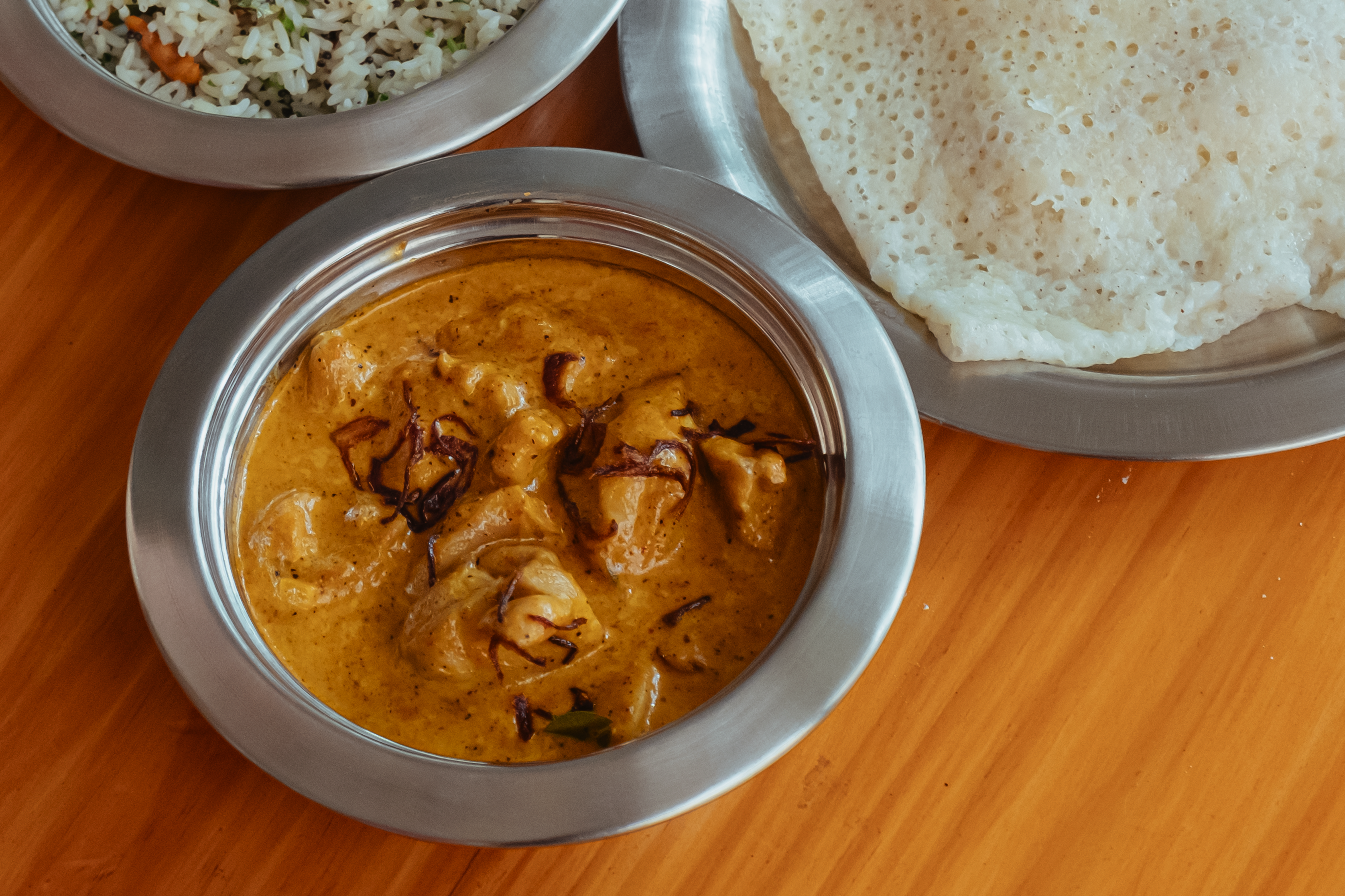
Every morning, Sandra and Solomon steer customers through the menu, explaining the importance of regional cuisine using local ingredients to tourists from across the country: neer dosas pair well with chicken gassi, a coconut milk-based stew, or a sardine curry, while TKC’s panchari chicken—a chicken stew made using five different seasonal greens and developed in-house—is an example of how local cuisines can adapt seasonally. They hope that this will direct tourists, an influential group with significant purchasing power, to consume more thoughtfully.
Do you know Surya from Galgibag? He forages for the best oysters to serve at his shack.
This education, increasingly, has become part of a chef’s responsibility, illustrates Devika Gowri, chef and founder of Alt Food Co, a community kitchen in Panaji that hosts cooking classes, workshops, and supper clubs. For instance, their popular cooking classes for children introduce millets—a hardy grain variety that has historically been marginalised from fields and palates—during baking sessions. Paired with field trips to local farms and conversations with food practitioners and chefs, this broadens children’s openness to trying local foods. Perhaps, more importantly, the classes also teach them about the people, hard work, and contexts that produce the food they eat.
For adults—who “don’t want to come for cooking classes”, laughs Gowri—Alt Food Co hosts discussions over relevant menus. A six-course meal centering chilli, for instance, becomes a conduit to discuss the ingredient’s fraught colonial past, and heat in the context of the climate crisis. Market walks and cooking workshops highlight how traditional foodways have historically been the most secure. Through these engagements, Gowri grounds larger political discussions about food in the embodied acts of cooking and eating. In turn, attendees take away knowledge about local food systems, and broaden their role in them beyond that of simple consumption.


In the face of current crises, one wonders whether sourcing locally, working with food producers, and educating consumers is enough. Madhav reminds me that many of the ingredients we take for granted today, such as guavas or kokum, might not be available in the near future, due to the climate crisis. Despite this sobering thought, these chefs remain hopeful. To practise their commitment, they continue planning their seasonal menus and spaces around the delayed monsoon.
Afshan Mariam is an educator, writer, and researcher whose work weaves together storytelling, ecology, and pedagogy. Rooted in questions of people, place, and interdependence, she finds meaning in designing learning spaces that centre respect, reciprocity, and responsibility. When she is not reading with her cats, Afshan is found walking through the many wild places she calls home.
Stephen Chinoy is a Goa-based photographer whose work spans editorial and commercial photography, with an emphasis on visual storytelling.
Make chicken gassi at home with this recipe by the kitchen collective.
This article has been published as a part of The Locavore’s collaboration with Powerhouse Museum, Australia. Titled ‘Setting The Table: Stories from India’s Food Cultures’, it aims to highlight diverse undertold stories about India’s culinary landscape to a non-native reader, adding texture to global narratives about Indian food.


Share this:
- Click to share on X (Opens in new window) X
- Click to share on Facebook (Opens in new window) Facebook
- Click to share on WhatsApp (Opens in new window) WhatsApp
- Click to email a link to a friend (Opens in new window) Email
- Click to share on LinkedIn (Opens in new window) LinkedIn
- Click to share on Reddit (Opens in new window) Reddit
- Click to print (Opens in new window) Print