
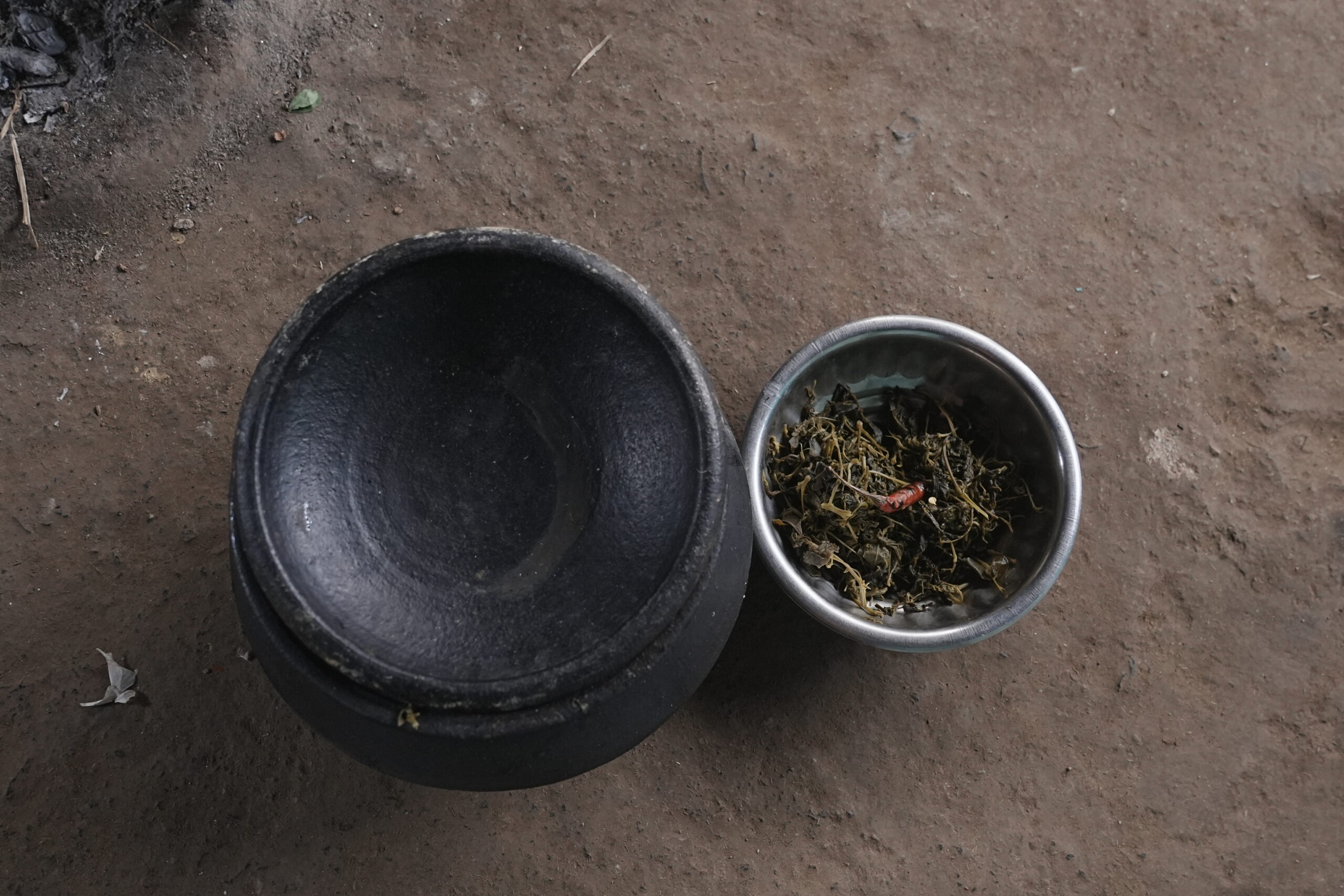
A traditional dish of the Gond and Baiga communities of Central India, Charota Bhaji is made from the leaves of the charota plant (also known as Sickle Senna), a wild green that grows abundantly during the monsoon months. For generations, families in villages like Lalipur in Madhya Pradesh’s Mandla district have gathered these leaves from the forest edges and fields, turning what grows freely around them into a dish that is both practical and rooted in local knowledge.
The leaves carry a natural bitterness that is removed by washing them, followed by gradual slow-boiling that takes out the harshness until only a gentle, earthy bitterness remains. This is then balanced with soaked dried mango, which stands in for tomatoes or tamarind in a region where such ingredients aren’t always within easy reach.
This bhaji is far more than just a side dish. In farming households, it is often paired with pej, a thin corn-based drink, to create a light but filling combination that keeps workers going through long hours in the fields, especially during the demanding planting season in the monsoon.
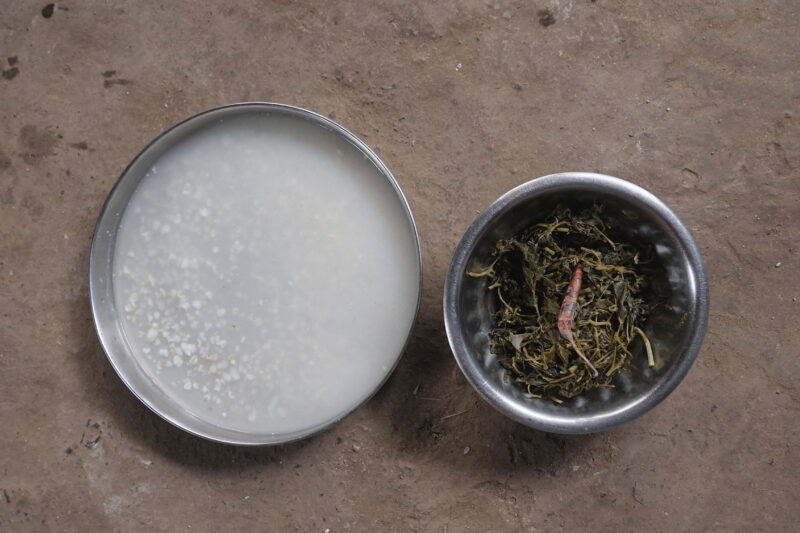
Caption: Pej and charota bhaji
Ingredients:
| Charota leaves | 250 grams |
|---|---|
| Dried raw mango (ambula) | 3–4 pieces |
| Water | 500 ml (2 cups), for soaking the ambula |
| Salt | to taste, optional |
What You Will Need
A vessel for soaking the leaves, a medium-sized kadhai or heavy-bottomed pot
Instructions
Wash the charota leaves thoroughly to remove any dirt or mud.
Drain the leaves, transfer them to a kadhai or heavy-bottomed pot, and cover with fresh water. Boil the leaves over medium heat for 2–3 hours, or until they are tender and the bitterness has reduced.
While the leaves are cooking, prepare the dried mango water. Soak 3–4 pieces of dried raw mango (ambula) in 500 ml (2 cups) water for 2-3 minutes. Remove the ambula pieces and reserve them to add to the bhaji.
Drain the excess water from the cooked leaves.
Add the soaked dried mango to the cooked leaves and mix well. Cook for a few minutes to allow the sour flavour to infuse the leaves.
Taste and add salt if desired. Serve hot.
Tips:
- Use your fingers to gently rub the leaves while washing—this helps release the bitterness faster than simply rinsing.
- If the leaves still taste too bitter after boiling, drain and add one more change of fresh water before adding the dried mango water.
- The dish is traditionally simple, but a tempering of mustard seeds and garlic in a little oil can be added at the end for flavour, without straying too far from the original preparation.
Variations:
- Some households add a handful of soaked chana dal or moong dal while boiling the leaves, making the bhaji more filling.
- In place of dried mango water, tamarind water or fresh raw mango can be used when available, though this slightly changes the traditional tang.
- A tempering (tadka) of mustard seeds, cumin seeds, and dried red chilli in mustard oil can be added just before serving for a more robust flavour profile, especially when the bhaji is served without pej.
Yashoda is a farmer and a midday-meal cook at an anganwadi school in Lalipur village of Mandla, Madhya Pradesh.
This recipe has been documented by Nidhi K. and photographed by Kiran Admache.
Nidhi K. is the Writer-Researcher Fellow from Madhya Pradesh for the Woman Farmer Project. She is an independent journalist from Mumbai who writes on travel, food, policy, public health, and the environment. A data nerd, she loves scouring databases to bring stories to the fore. Nidhi is currently learning Italian for fun, and building the courage to start her own newsletter on autism.
Kiran Admache is the Audio-Visual Fellow from Madhya Pradesh for the Woman Farmer Project. A Gond Adivasi filmmaker and engineer from Seoni, Madhya Pradesh, she holds a Bachelor’s degree in Electrical and Electronics Engineering and is an alumna of the Green Hub Central India Fellowship where she learned documentary filmmaking. She has worked with organisations such as PRADAN in Rajasthan, Wild Harvest in Jharkhand, and Samagra Seva in Bihar as a freelance filmmaker. Currently, she is part of CICADA, a tribal filmmakers’ collective, where she co-runs community film clubs.
This story is part of the Woman Farmer Project, a multimedia storytelling initiative led by The Locavore in partnership with the Doc Society Climate Story Kitchen. It aims to build a roadmap for successful collaborations between institutions and innovative grassroots networks who are committed to amplifying climate stories.
The Doc Society supports climate action across the globe by championing independent filmmakers, audio producers, journalists, and artists working alongside impact producers and movement builders to bring more communities into climate conversations to advance climate just and biodiverse futures.
Editor: Ishani Banerjee
Copy editor: Khorshed Deboo
You must be logged in to rate this recipe.
 Login with Google
Sign in with email