
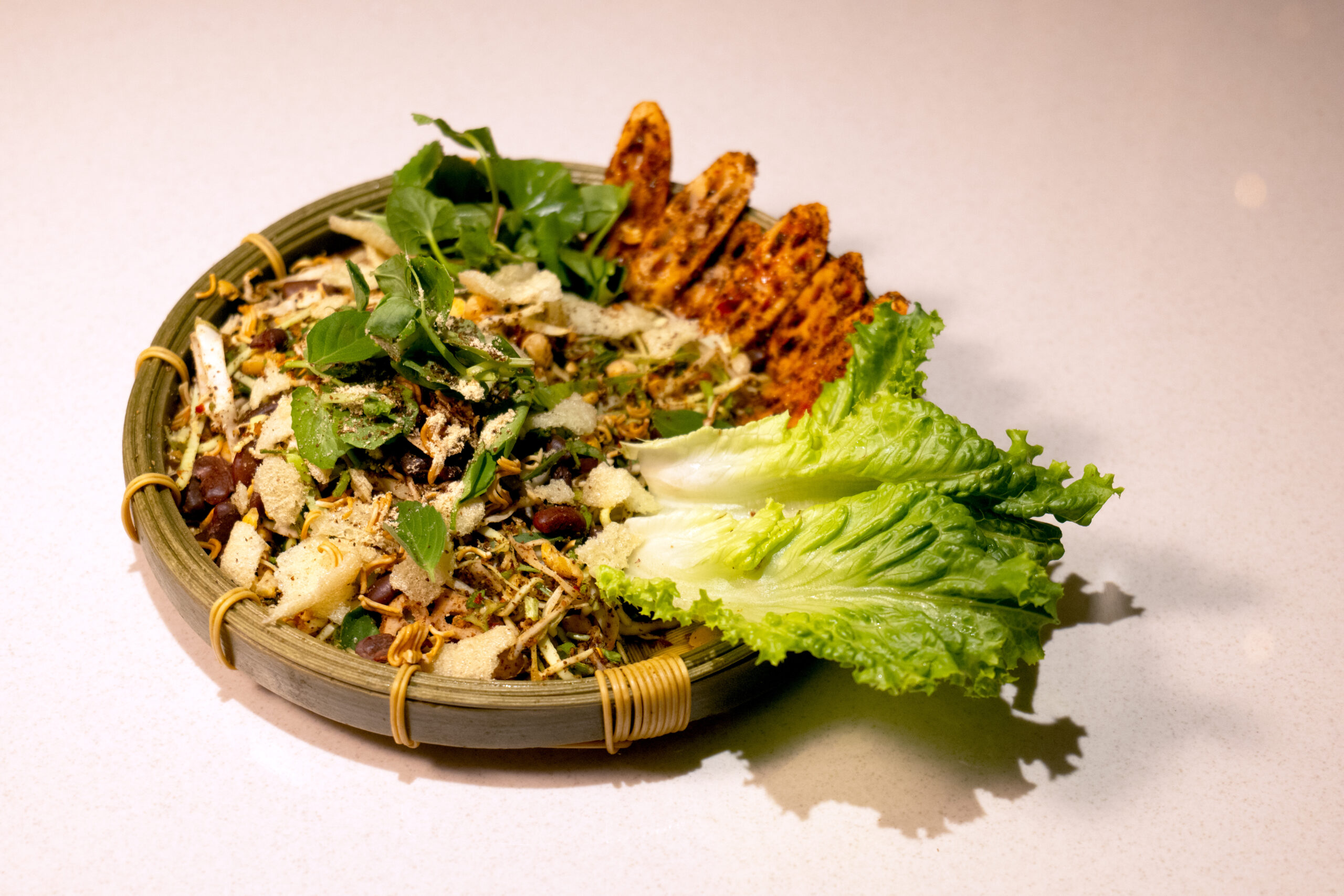
Singju is a salad from Manipur, built on the same principles as any other traditional salad: a base, a dressing and a handful of toppings for texture. But what defines it is its use of seasonal and local ingredients. The base uses seasonal vegetables and boiled rice beans (called chakhawai in Meitei), changing through the year depending on what is available. The dressing is made from toasted and ground perilla seeds, toasted gram flour, chilli flakes and ngari, a fermented dried fish that is first boiled or toasted, then turned into a paste.
Within the Meitei community, there are two common versions of singju. The vegetarian version relies on the earthy flavour of perilla seeds, while the non-vegetarian one centres on the strong, fermented taste of ngari. This difference, Chef Nikesh says, comes from the influence of temple food—on religious days, fermented fish is avoided, so the perilla-forward version is prepared. In the hill regions of Manipur, where 20–30 tribes live, there is a third version that uses smoked meat instead of fish.
In Manipur, singju is a part of everyday life. Nikesh recalls how every locality had an ene (aunt) who sold singju in cones of newspaper lined with banana leaf. Children walking home from school would stop by, buy a few cones, sit together, and crush the toppings over the salad before eating. He says singju is best enjoyed communally.
For the base
| Dried rice beans (Vigna umbellata or chakhawai) | 4 tbsp |
|---|---|
| Cabbage, finely shredded | 150 g / 2 cups |
| Water spinach (kangkong), destemmed | 60 g / 1 cup |
| Pea shoots | 50 g / ½ cup |
| Pennywort leaves (gotu kola) | 15-20 g / ½ cup |
| Lemon basil, chopped | 10 g / ½ cup |
| Fresh ginger, julienned | 1 tsp |
| Lotus stems | 100 g / 1 cup |
For the dressing
| Perilla seeds | 2 tbsp |
|---|---|
| Besan | 1 tbsp |
| Chilli flakes | ½ tsp |
| Ngari (fermented dried fish) | 1 tsp |
| Salt | To taste |
For the toppings
| Matar | ¼ cup |
|---|---|
| Cooked papad | 1 piece (6-8 inches in diameter when cooked) |
| Uncooked instant noodles (eg. Wai Wai) | 250 g |
| Butter lettuce, washed | A few leaves for serving |
What You Will Need
Mixing bowls, sharp knife, saucepan, frying pan, mortar and pestle or spice grinder
Instructions
Begin by preparing the chakhawai. Rinse the beans until the water runs clear, then soak them in plenty of fresh water for at least 4 hours or overnight. Drain, transfer to a saucepan, cover with fresh water by an inch and bring to the boil. Reduce to a gentle simmer and cook for 25 minutes or until tender but still holding their shape. Drain well and spread out to cool completely.
Prepare the fresh vegetables. Start with the cabbage: remove any wilted outer leaves, rinse the head thoroughly under cold running water, and pat dry. Cut the cabbage into quarters, slice out the hard core from each piece, then finely slice the leaves into thin ribbons about 2-3 mm wide. Place the cabbage in a large mixing bowl.
Next, prepare the water spinach. Rinse leaves carefully to wash away any grit. Bring a saucepan of water to a boil, and once it is bubbling steadily, add the water spinach. Blanch for 30-40 seconds, until the leaves soften and turn a vibrant green. Immediately transfer the blanched greens to a bowl of ice-cold water to stop the cooking and preserve the colour. Once cool, squeeze out the excess water gently with your hands and roughly chop. Add these to the bowl with the cabbage.
For the pea shoots, rinse them gently under cold water, taking care not to bruise the tender leaves. Shake off the excess moisture or pat dry lightly with a clean cloth. Trim away any thick stems, keeping only the soft leaves and delicate tips. Add these to the vegetables.
Prepare the pennywort by picking through the leaves and discarding any yellowed or damaged ones. Rinse the leaves thoroughly in a bowl of cold water, lifting them out so any grit settles at the bottom. Pat dry and slice any larger leaves into halves or thirds. Add to the bowl with cabbage, water spinach, and pea shoots.
Measure out four tablespoons of the chakhawai to add to the vegetables. Set aside.
Wash the lemon basil and pat it dry. Remove any thick stems and chop the leaves roughly into small pieces. Peel a small piece of ginger and slice it into thin julienne pieces. Add the lemon basil and ginger to the bowl with the prepared vegetables.
For the lotus stems, lightly scrape the skin with a knife to remove any fibres and rinse thoroughly, ensuring the holes are flushed clean. Slice the stems into thin 1-2 mm rounds.
To prepare the dressing, place the perilla seeds in a dry frying pan set over medium heat. Toast for 2-3 minutes, stirring constantly, until they release a nutty aroma and start to pop slightly. Remove the seeds from the pan and allow to cool, then grind them to a fine powder using a mortar and pestle or spice grinder.
In the same pan, add the besan and toast gently over low heat for 3-4 minutes, stirring continuously, until the flour turns a pale golden colour and smells warm and nutty. Transfer the toasted flour to a plate and allow to cool completely.
Prepare ngari using one of two methods:
a. For a milder flavour, place the fermented dried fish in a small pan with a tablespoon or two of water and simmer gently for 3-4 minutes until softened. Drain and pound into a paste using a mortar and pestle.
b. For a stronger, smokier flavour, dry-toast the ngari directly over low flame for 2-3 minutes until crisp, then grind into a coarse powder.
In a small bowl, combine the ground perilla seeds, toasted besan, chilli flakes and salt. Add the ngari and mix together thoroughly until evenly combined.
To assemble the singju, add the cooled chakhawai, lemon basil and ginger to the prepared vegetables. Sprinkle the dry dressing mixture over the contents of the bowl. Using clean hands, lift and fold the vegetables repeatedly to ensure that the dressing coats every ingredient evenly. Singju should remain dry and lightly textured, so continue mixing until everything is well coated but not clumped together. Allow the mixture to rest for 3-5 minutes so that the ingredients and dressing meld and macerate together, and the flavours of the salad become more pronounced.
Just before serving, prepare the toppings. Lightly crush the fried matar using your fingers. Break the fried papad into small, bite-sized pieces. Crush the uncooked instant noodles directly from the packet. Scatter all the toppings over the dressed salad and give it one very gentle toss to preserve the crunch.
Line a serving plate with a few fresh lettuce leaves and pile the singju neatly on top.
Singju is best enjoyed with Manipuri red tea and potato fritters.
Tips:
- Slice all vegetables as finely and evenly as possible.
- Keep the vegetables completely dry before mixing; excess moisture will make the dressing clump.
- Add toppings last to retain crunch.
Nikesh Asem (@nikasem) studied at the Manipal Welcomgroup Graduate School of Hotel Administration before completing his Master’s in Italian Cuisine in Canada. He then worked as a head chef on the Amalfi Coast, Italy, but eventually returned to India to cook food that felt closer to home. He now runs Hentak, a Manipuri restaurant in Delhi’s Humayunpur market, and hosts pop-ups in Delhi and Mumbai to share Manipuri food with a wider audience.
This article has been published as a part of The Locavore’s collaboration with Powerhouse Museum, Australia. Titled Setting The Table: Stories from India’s Food Cultures, it aims to highlight diverse undertold stories about India’s culinary landscape to a non-native reader, adding texture to global narratives about Indian food.


You must be logged in to rate this recipe.

 Login with Google