

This recipe has been excerpted from Silent Cuisines: The Unsung & Disappearing Foodways of Gujarat’s Adivasis by Sheetal Bhatt, a cookbook documenting some of the culinary traditions of tribes from the foothills of the Aravalli mountains of Gujarat, across six northeastern districts of the state.
Silent Cuisines first began as an attempt to document Gujarat’s folk rice varieties, kept alive by custodian Adivasi communities. With Aranya, a Farmer Producer Organisation run by small and marginal Adivasi farmers from the forests of the Aravalli hills, and Paulomee Mistry, director of Aranya, Sheetal was able to access regions where certain traditional varieties were still grown and eaten. However, as they spent time in the thick forests and dense vegetation of the region, it became apparent that rice was only one part of a diverse foodscape of pulses, grains, and native wild greens that were still grown in these unspoiled lands and eaten by the Garasia, Dungri Garasia, and Bhil communities in the region.
Vatelo Masalo is a fiery and flavourful hand-pounded masala paste. In many of the homes Sheetal visited, it was prepared fresh every morning in a stone mortar, and then used throughout the day, infusing each meal with its bright flavours and nourishing goodness. The ingredients—which vary by season—are pounded rhythmically with salt until a fragrant, homogenous paste is formed.
The recipes in this book, of which the Vaatelo Masalo is one, cover what is eaten across all seasons in districts of northeast Gujarat—specifically the districts of Banaskantha, Sabarkantha, Aravalli, Mahisagar, Dahod, and Panchmahal. As community elders express concern over these disappearing foodways, with government schemes and younger generations’ tastes prioritising more commercial or popular foods, this documentation is an attempt to preserve the tastes and flavours of a region, and offer it the tools of aspiration—beautiful photos and publication—that could contribute to keeping them alive.
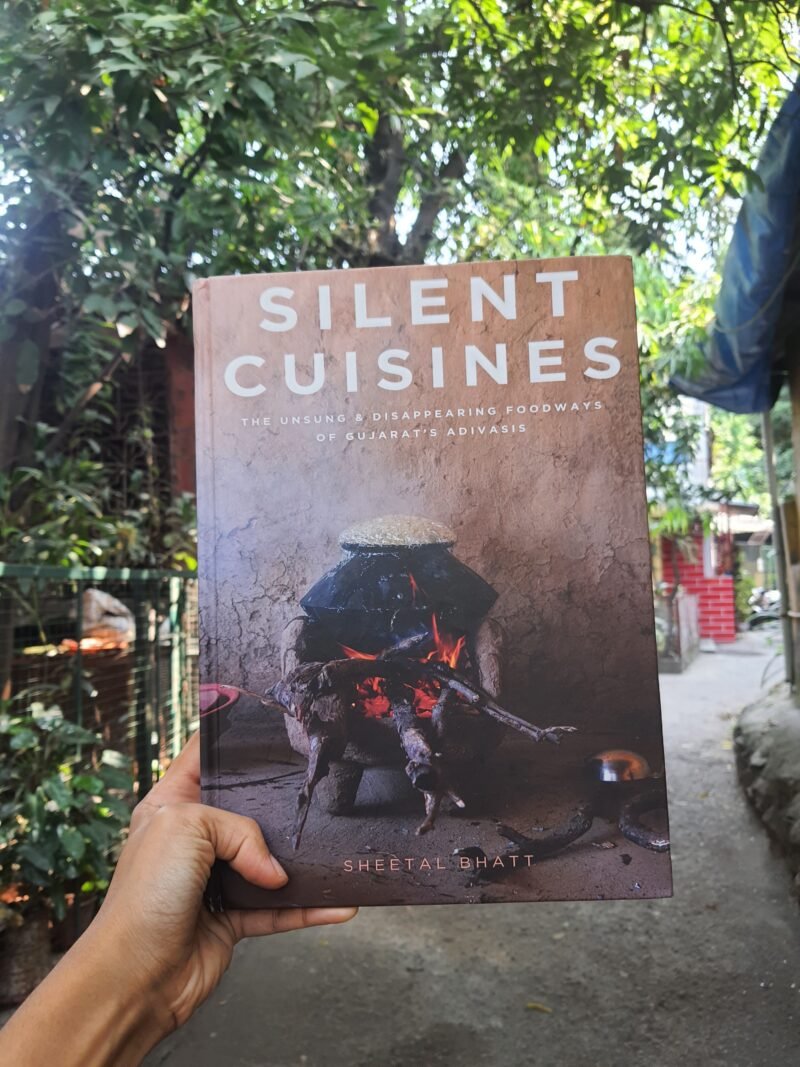
Silent Cuisines, a project of Disha, authored and photographed by Sheetal Bhatt.
Red Masala (Year-round)
| Desi garlic (smaller, pink variety) cloves | 8-10 |
|---|---|
| Dried red chillies (a mix of hot and mellow varieties) | 5-6 |
| Coriander seeds | 3 teaspoons |
| Cumin seeds | 1 teaspoon |
| Black peppercorn | 6-7 |
| Fennel seeds (optional) | 1 teaspoon |
| Cinnamon stick (optional) | 1 |
| Star anise (optional) | ½ |
| Dagad phool (Black stone flower) (optional) | 1 |
| Salt | to taste |
Green Masala (Winter)
| Green garlic chives | a handful/ 25-30 grams |
|---|---|
| Green chillies | 3-5 |
| Tender coriander with stems | a handful/ 20-25 grams |
| Coriander seeds | 3 teaspoons |
| Cumin seeds | 1 teaspoon |
| Salt | to taste |
What You Will Need
A mortar and pestle
Instructions
Hand-pound the ingredients under each masala consistently until a homogenous mixture is formed.
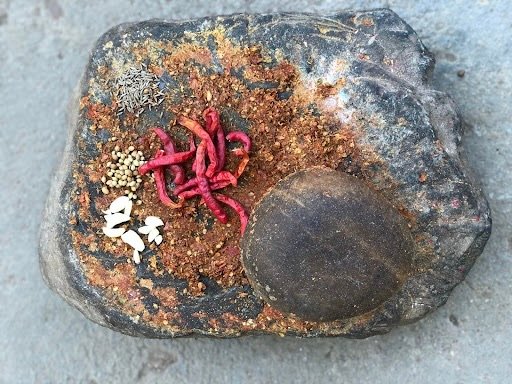
Vaatelo Masalo is meant to be ground fresh every morning. Photo by Sheetal Bhatt.
Sheetal Bhatt is a social development professional by training and has worked extensively with marginalised communities in Gujarat. Her journey into the study of food and hyper-local regional Gujarati cuisines began a decade ago with her website, www.Theroute2roots.com.
You can find more recipes and their stories from Silent Cuisines here and here.
You must be logged in to rate this recipe.
 Login with Google
Sign in with email