
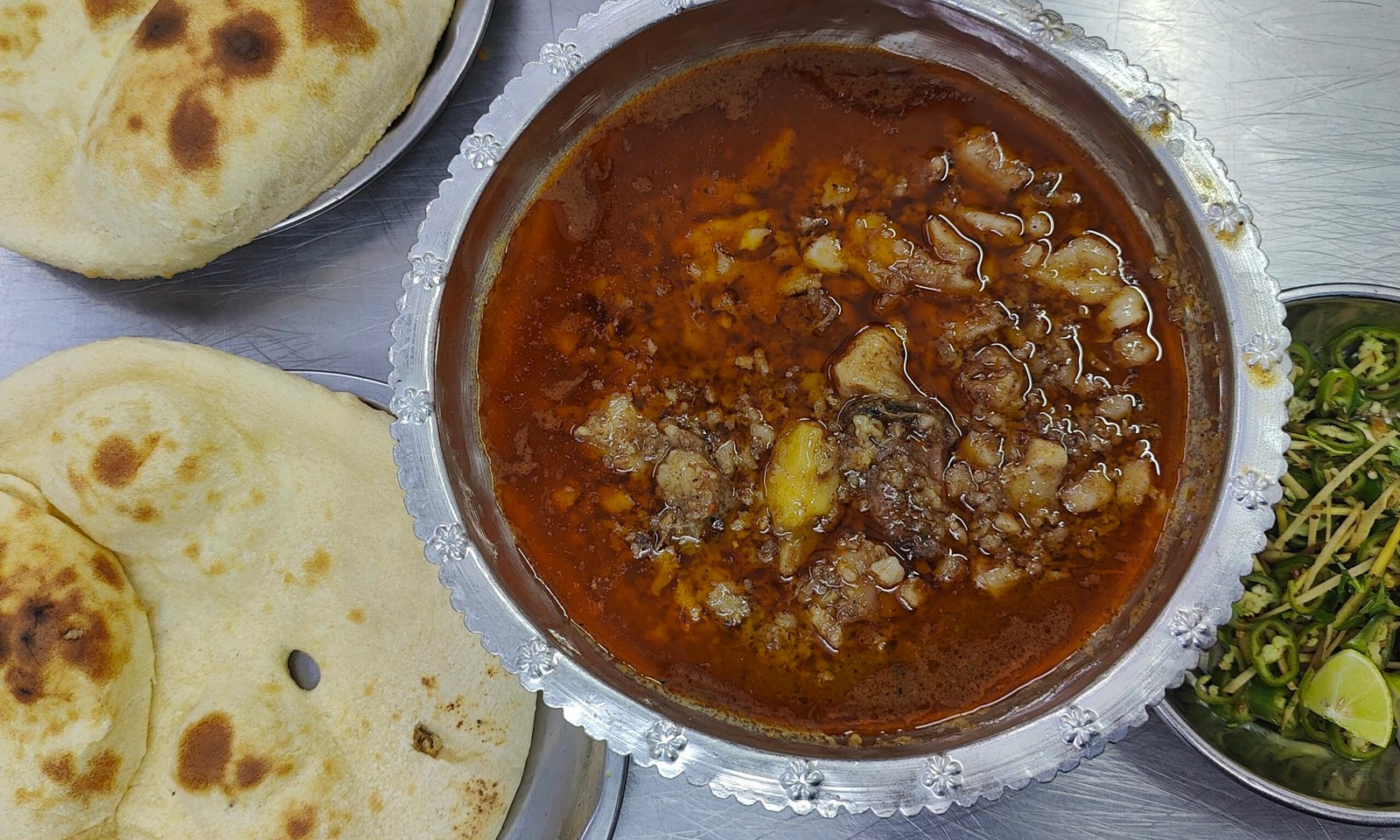
Sadaf Hussain remembers his first taste of Purani Dilli nihari. He laughs and calls it “terrible.” He had grown up eating nihari in Ranchi and Bihar, where nihari always meant paya.
For him, Delhi’s version was completely different. There were no bones, the curry was thick, and the soft pieces of meat were slow-cooked for hours with marrow. With time, Sadaf realised that this was simply how Dilli nihari was meant to be. It wasn’t chunky, and he eventually began to take a liking to it. “Ab mujhe lagta hai nihari aisi hi honi chahiye,” he says—now he believes nihari should be made the Delhi way.
In his book Masala Mandi: A Guide to the World of Indian Spice Blends (2024), Sadaf writes, “Even with different variations or versions, one thing will always remain the same (luckily)—nihari will be slow-cooked overnight in large pots to ensure the flavour is absorbed into the meat. One benchmark, while preparing this dish, is that the meat should disintegrate and blend with the gravy. From Delhi’s Kallu Nihari, Haji Shabrati to Lucknow’s Rahim Nihari, to Kala Khan Nihari House in Rawalpindi and Zahid Nihari in Karachi—all follow the same template. While a standard accompaniment is khamiri roti, you can also ask for maghaz (brain) and extra butter or ghee on top.”
| Coriander seeds | 2 ½ tablespoons |
|---|---|
| Fennel seeds | 1 ½ tablespoons |
| Black pepper | 1 teaspoon |
| Green cardamom | 10-12 |
| Cloves | 20 |
| Black cardamom | 2 |
| Star anise | 3-4 |
| Long pepper | 3 |
| Bay leaves | 4 |
| Nutmeg, whole | ½ |
| Mace blades | 8-10 |
| Dried ginger powder | 1 tablespoon |
| Boriya chilli, powdered | 15-20 |
| Kachri powder | 1 ½ tablespoon |
| Red chilli powder | 1 tablespoon |
| Salt | to taste |
What You Will Need
Flat frying-pan; spice grinder
Instructions
In a dry pan over medium heat, add the coriander seeds, fennel seeds, black pepper, green cardamom pods, cloves, black cardamom pods, star anise, long pepper, and bay leaves. Roast for 1-2 minutes, stirring constantly until the spices turn fragrant. Be careful not to burn them.
Allow the roasted spices to cool completely. Transfer to a spice grinder and grind into a fine powder.
In a bowl, combine the freshly ground spices along with nutmeg, mace, dried ginger powder, boriya chilli powder, kachri powder, red chilli powder, and salt. Mix thoroughly to ensure an even distribution of flavours.
Transfer to an airtight container and store.
Tips:
This nihari masala can be used to make nihari at home—you can adjust the amount of spice blend to suit your taste. To begin, heat ghee, oil, or mustard oil in a ‘degh’. Once the fat is hot, add sliced onions and brown them well. Add the nihari masala and the meat. For 1 kilogram of meat, use about 50–60 grams of masala and 300–400 grams of onions. The nihari will take about 8–9 hours to cook slowly until the meat is tender and the flavours deepen.
If you’re using a pressure cooker, brown the onions, add the meat, and cook until the meat changes colour. Then add a slurry of aata (wheat flour), mix well, close the lid, and cook for 8–9 whistles. The meat should fall off the bone. If the nihari isn’t spicy enough, adjust the masala and salt to taste. Serve hot with ghee.
Variations:
Raw papaya paste can be used instead of kachri powder.
This recipe is from ‘Masala Mandi: A Guide to the World of Indian Spice Blends’ by Sadaf Hussain, published in 2024 (Penguin Random House India). Excerpted with permission from the author and the publisher.
Sadaf Hussain is a chef, food writer, and two-time TEDx speaker who co-hosts the podcast ‘Naan Curry’. His work spans restaurant consulting, research projects, and essays that explore not just food but the histories, customs, and stories surrounding it.
In December 2025, Sadaf led a street food walk at Shaheen Bagh, Delhi for the The Local Food Club community—read about it here.
You must be logged in to rate this recipe.
 Login with Google
Sign in with email