
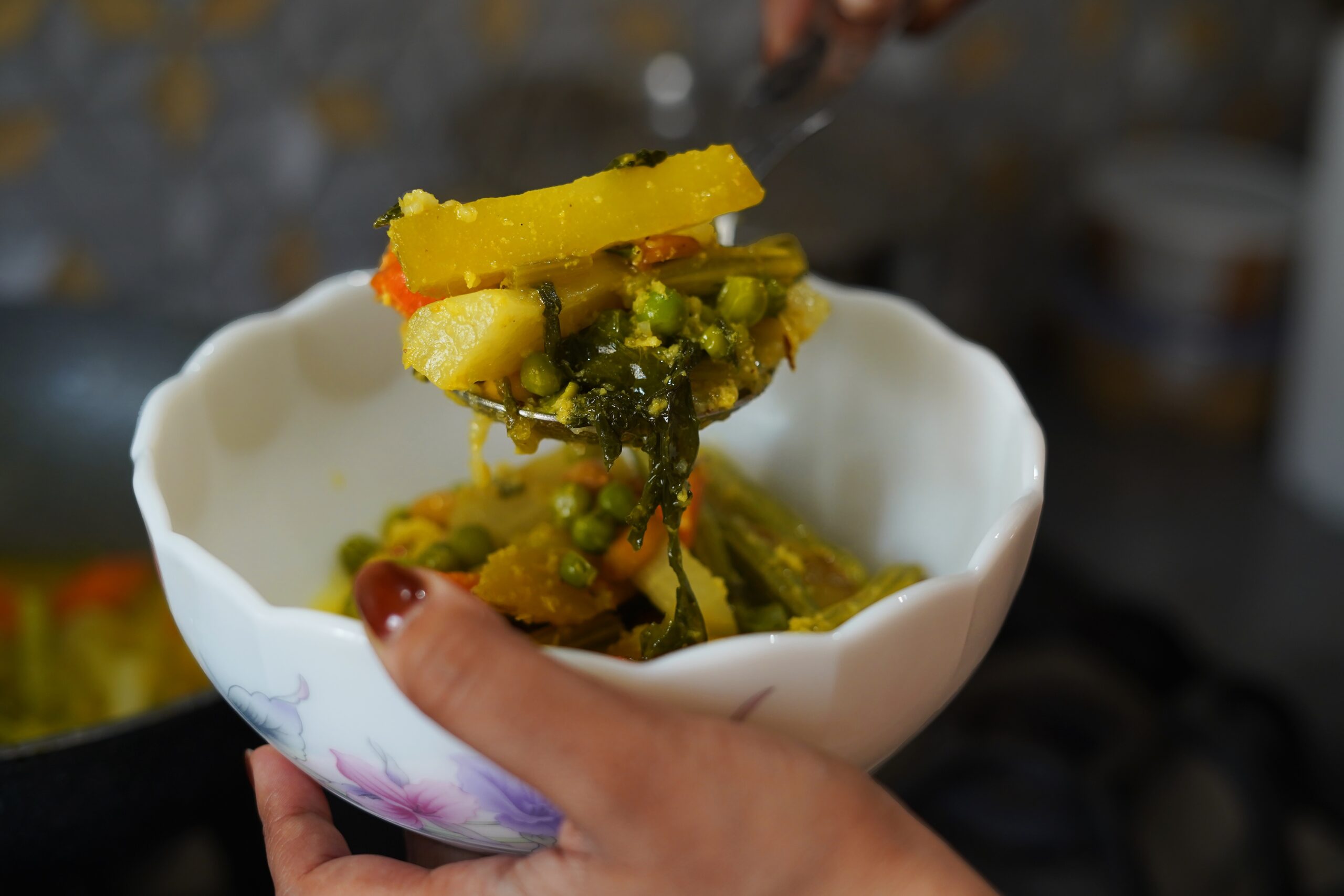
A chorchori (also spelt ‘charchari’ or ‘chadachadi’) is a dish common to West Bengal and Odisha, known for its medley of vegetables cooked with aromatic spices, minimal water and a slightly charred, sizzling finish. The name itself hints at this technique, referring to the gentle caramelisation that occurs as the vegetables fry in oil.
Bengal has a long history of cooking shaped by scarcity. The famine of 1943, in particular, gave rise to many dishes that relied on zero-waste practices or made use of ingredients typically considered undesirable. Chef Sohini Banerjee recalls encountering such a mindset in her own home. “I grew up having this sort of preparation so frequently because any time we brought home vegetables like radish and cauliflower, the women of the household would use all the leaves instead of wasting them,” she says.
Most chorchoris, like this one, are an opportunity to use up leftover vegetables, or the leaves and stems of produce that would otherwise be thrown away. While many variations use leftover parts of fish—like the bones of a fish cooked until softened or the oily fish head—this version is entirely vegetarian and uses radish leaves, moringa pods, and peas as its primary greens. Moringa pods, also known as drumsticks, are the long, slender, and slightly ridged seed pods of the Moringa oleifera tree. These green pods are best when young and tender, turning brown as they mature. Due to their fibrous nature, when cooked and eaten, they typically have to be chewed on to extract the flesh and flavour before the remaining fibre is discarded.
| Moringa pods | 200-220 grams/ 1 cup |
|---|---|
| Red or white radish | 120 grams/ 1 cup |
| Radish leaves | 40-50 grams/ 1 cup |
| Potatoes | 150 grams / approx. 1-2 |
| Carrots | 130 grams / approx. 2 |
| Green chilli | 1 |
| Fresh coconut | 1 |
| Raw peanuts | 10 grams / 1 tbsp |
| Cold-pressed mustard oil | 2 tbsp |
| Fresh ginger, peeled and finely grated | 5 grams / 1 teaspoon |
| Turmeric powder | ¼ teaspoon |
| White sugar | ½ teaspoon |
| Salt | To taste |
| Green peas, fresh or frozen | 60 grams / ½ cup |
| Water | ¼ cup |
What You Will Need
Sharp knife; grater; chopping board; flat skillet; heavy-bottomed pan
Instructions
Wash all the vegetables thoroughly to remove any dirt. Shake off excess water.
Trim the ends of the moringa pods and cut them into pieces, about 4–5 cm long. Set aside.
Cut the root and stem ends off the radishes. If using white radish, peel and slice into batons approximately 2 cm thick. If using red radishes, slice into 2 cm pieces. Set aside.
Roughly chop the radish leaves and set them aside. Peel the potatoes and cut them into even wedges, approximately 2 cm thick. Place the wedges in a bowl of water so they do not discolour.
Peel the carrots and slice them into batons of a similar thickness to the potato and radish. Set aside.
Remove the stalk from the green chilli and break it in half crossways.
To prepare the fresh coconut, place the whole coconut on a stable surface. Use a heavy knife or the back of a cleaver to tap firmly around the middle of the coconut, rotating it as you tap, until it cracks open into two halves. Collect the coconut water and save it (or drink it).
Slide a knife between the white coconut flesh and shell, and work slowly around the curve to gently separate the flesh from the shell. The flesh should come away in pieces. If a thin brown skin is attached to the flesh, remove using a knife or vegetable peeler as it can be slightly bitter.
Grate the coconut flesh finely, applying steady pressure. Measure out one tablespoon for the recipe and set aside.
In a flat skillet, dry-roast the raw peanuts on low flame for about 2 minutes or until lightly browned. Set aside.
Place a heavy-based pan or kadhai on medium heat and add the mustard oil. Heat until the oil begins to smoke lightly, indicating it is ready (see Tips). Lower the heat slightly.
Add the ginger to the hot oil, followed immediately by the halved green chilli. Stir continuously for 30 seconds.
Drain the potato wedges and add to the pan. Stir well until all the wedges are coated in the mustard oil. Cook the potato for 5 minutes, stirring occasionally, until the edges begin to look glossy and slightly translucent.
Add the carrots to the pan and sauté for 1–2 minutes, until the colour brightens slightly. Next, add the moringa pods and radishes. Stir and cook for another 2 minutes, allowing the vegetables to soften slightly while still holding their shape.
Add the radish leaves and stir gently. They will wilt almost immediately and turn a deep green.
Sprinkle in turmeric powder, sugar, and salt (see Tips). Mix thoroughly so the seasoning is evenly distributed. Cook for 4–5 minutes, stirring occasionally.
Add the grated coconut, toasted peanuts, and peas to the pan and stir gently so the coconut does not stick to the bottom. Add ¼ cup of water, cover the pan with a lid, and cook on medium heat for 6–7 minutes. The peas should become tender, and the coconut should smell nutty rather than raw.
Remove the lid and give the vegetables a final stir. Check the seasoning and adjust the salt to taste. The vegetables should be tender when pierced with a knife, with no excess moisture in the pan.
The chorchori is best enjoyed with plain steamed rice.
Tips:
- Mustard oil tastes pungent if not heated until lightly smoking. Heat the mustard oil until it thins and begins to shimmer, with faint ripples on the surface, then lower the heat before adding the ginger and chilli so they do not burn. If it starts smoking too strongly, remove the pan from the heat briefly to cool slightly before adding the ginger and chilli.
- Slice the potatoes, carrots, and radishes to roughly the same thickness so they cook evenly.
- Hard vegetables (potatoes and carrots) need more time to cook, which is why they are added before the radishes and radish leaves.
- Allow the vegetables to sit in the pan briefly between stirring. This helps them soften and develop flavour.
- Add only a small amount of salt initially, as radishes and radish leaves release moisture while cooking. Adjust the seasoning at the end once the vegetables are fully cooked.
Sohini Banerjee is the chef and writer behind Smoke and Lime, a London-based Bengali zero-waste supper club and culinary project exploring heritage, memory, and sustainability through food.
This recipe has been published as a part of The Locavore’s collaboration with Powerhouse Museum, Australia. Titled Setting The Table: Stories from India’s Food Cultures, it aims to highlight diverse undertold stories about India’s culinary landscape to a non-native reader, adding texture to global narratives about Indian food.
Read more about no-waste Bengali cooking in this article.


You must be logged in to rate this recipe.
 Login with Google
Sign in with email