
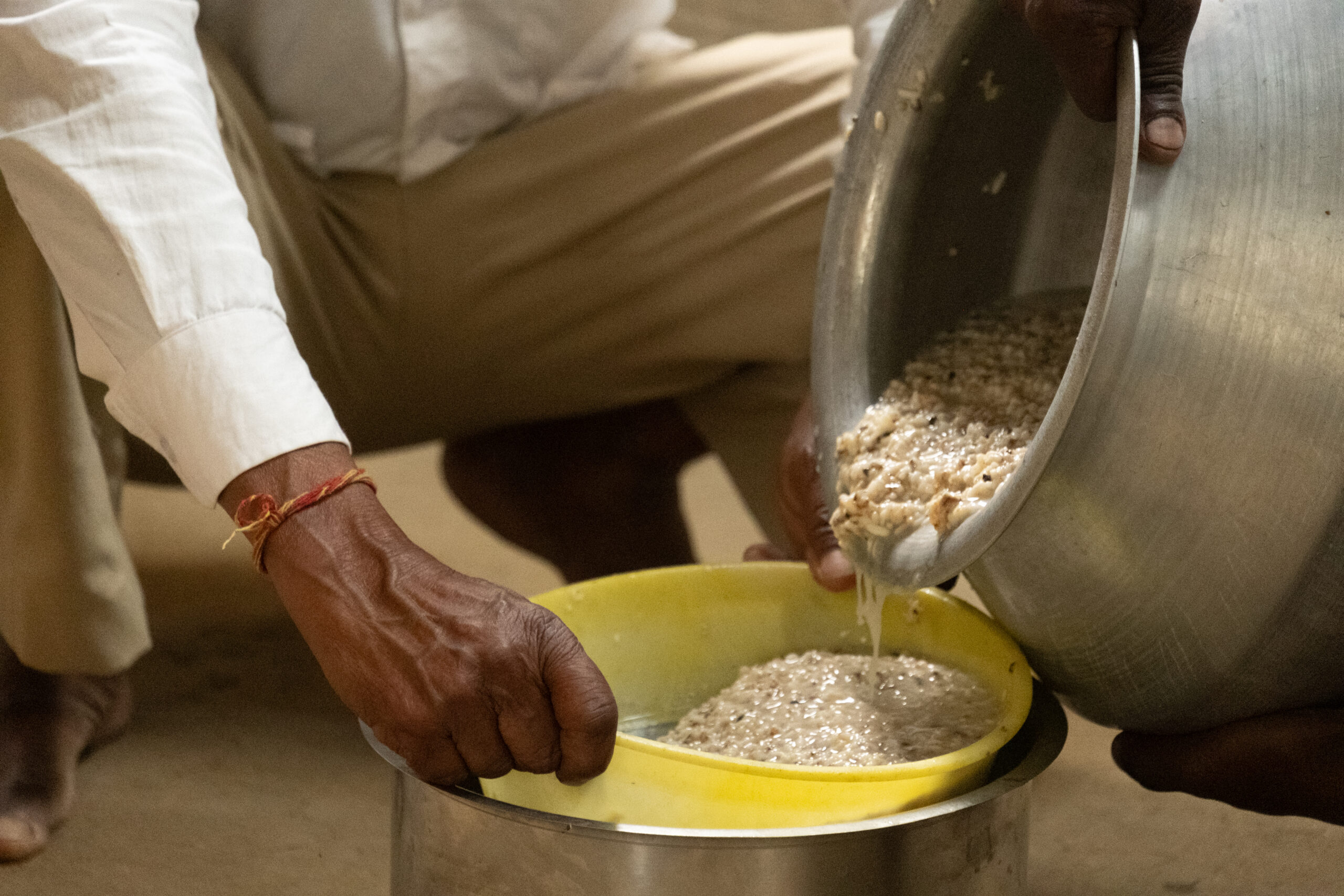
Cover photo by Niviya Vas
In Jharkhand’s dense, red-soiled landscapes, handiya has been brewed and shared for centuries. A traditional rice beer prepared and consumed across the state, it is intrinsic to Adivasi social and cultural life, among communities such as the Santal, Munda, Ho, and Oraon. During the harvest festival of Sohrai, it accompanies acts of worship and celebration.
At the crux of the fermentation process undertaken to prepare handiya are ranu tablets—the microbial and aromatic foundation of the brew. These small, hand-formed cakes are made by pounding rice together with a range of locally available herbs and roots, each lending distinct properties to the process. There is no prescribed composition: some households work with eight ingredients, others with 20 or more. The formulation is shaped by ecological availability as well as inherited knowledge, with selections guided by what grows in the immediate landscape and what is recognised by elders as effective and appropriate.
Santali myth describes a divine creator passing on the knowledge of fermentation to the first human pair, who prepared handiya and offered it in return. In this telling, the act of brewing is not only technical but relational, connecting human life to the land, to inherited knowledge, and to what is sacred.
| Short-grain rice | 350-400 grams |
|---|---|
| Ranu (fermentation tablets) | 2 |
| Water | as needed |
What You Will Need
Heavy-bottomed saucepan or pressure cooker, Wide tray or clean cloth, Mortar and pestle, Large mixing bowl, Earthen pot (handi) or any non-reactive container, Clean muslin cloth or lid (to cover the container)
Instructions
Begin by preparing the rice. In many traditional contexts, the rice is not washed, as the surface starch is considered beneficial for fermentation. If you do choose to rinse it, do so lightly without over-washing. Cook the rice in a heavy-bottomed saucepan or pressure cooker, using slightly less water than usual so that the grains remain separate and not overly soft.
Once the rice is cooked, spread it out in a wide tray or on a clean piece of cloth. Allow it to cool completely to room temperature. This step is important, as adding the starter to warm rice can kill the natural microbes responsible for fermentation.
While the rice is cooling, take the fermentation tablets and crush them into a fine powder using a mortar and pestle or by hand. Make sure the powder is evenly crushed, without any large lumps.
When the rice has cooled fully, transfer it to a large, clean bowl. Sprinkle the powdered starter evenly over the rice. Using clean hands, gently mix the rice so that the starter is well distributed throughout. Avoid pressing or mashing the grains too much.
Next, transfer this mixture into a clean earthen pot or any non-reactive container. Pack it lightly—do not compress it tightly, as some airflow helps fermentation. Cover the container with a lid or cloth.
Place the container in a warm, dark spot and allow it to ferment undisturbed for 3 to 5 days. The exact duration will depend on the ambient temperature; warmer conditions will speed up fermentation. Over time, the rice will begin to release liquid and develop a mildly sour, alcohol-like aroma.
Once fermented, you can consume handiya by adding water to the fermented rice, leave it for at least 30 minutes and then strain to produce a cloudy, mildly alcoholic drink.
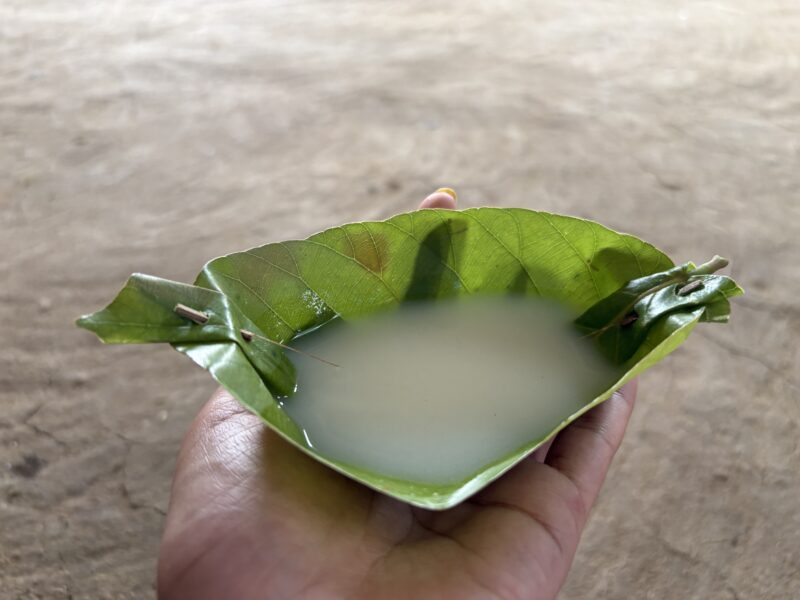
Note: There isn’t a fixed ratio for how much water to add. For handiya made with 350 g of rice, begin by adding about 500 ml of water to the fermented rice and let it rest for 30 minutes. Strain and taste. You can continue adding more water in batches, depending on your preference. In total, you may add up to approximately 1.4–1.5 litres of water.
Tips:
- Ensure the rice has cooled completely before adding the starter; even slight warmth can disrupt fermentation.
- Keep the fermentation vessel in a consistently warm, undisturbed space—temperature fluctuations can affect flavour and fermentation time.
- Avoid overpacking the rice into the container; a loose structure allows better microbial activity.
- If the smell turns unpleasantly sharp or rotten rather than mildly sour, it may indicate contamination and is best discarded.
- Adding whole dried red chillies at the top of the ferment is a practice seen in some households. While it does not significantly alter the heat of the drink, it can lend a subtle aroma and is also believed to help protect the ferment.
- When cooking the rice, use slightly less water than usual. The aim is to cook it just until done, so that the grains hold their shape and are not overly soft. All the water should be fully absorbed, as excess moisture can dilute the fermentation and affect the final flavour.
Variations:
- The same fermentation process can be used with other grains such as millets, resulting in drinks with slightly earthier, nuttier profiles.
- For a lighter drink, increase the amount of water when mixing the fermented rice; for a stronger version, use less water and allow a slightly longer fermentation time.
- Ranu is the traditional fermentation starter used in Jharkhand. Other regions across India use different starter cultures for rice beer. These can be used as substitutes, but their flavour will differ from a traditional handiya.
This recipe was documented during the Chef on the Road (COTR) trip to Jharkhand in March 2026, within the Dipatoli community, a settlement of seven homes on the outskirts of Ranchi, by Ishani Banerjee. Ishani is a culinary researcher at The Locavore, where her work engages with regional food systems and ingredients.
You must be logged in to rate this recipe.
 Login with Google
Sign in with email