
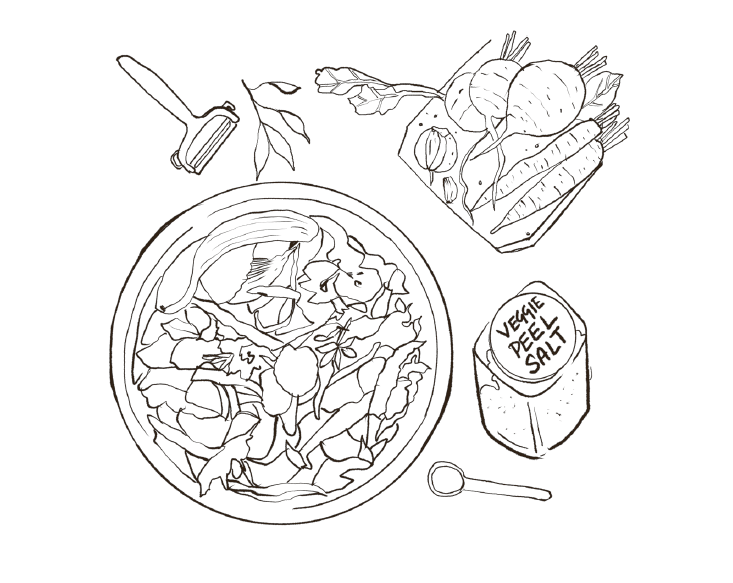
In 2016, while living alone in Ahmedabad, Arina Schude became acutely aware of how much food waste was generated in everyday cooking. Shopping and cooking for one often meant dealing with leftovers, spoiled greens, or piles of discarded scraps. This observation marked the beginning of her journey into what she now calls “trash-to-treasure” cooking—a way to rethink how we use ingredients and reduce waste in the kitchen.
It was an invitation to conduct a workshop on reducing kitchen waste that first sowed the seeds for Arina’s experiments. Expecting disinterest, she was surprised by the enthusiasm of the participants—mostly home cooks eager to learn new ways of reusing food creatively. The workshop turned into a lively exchange of traditional and modern methods, reinforcing her belief that no-waste cooking wasn’t a new idea, but a forgotten practice deeply rooted in Indian homes.
Motivated by the experience, Arina began researching waste generated before cooking even began, experimenting with recipes that used every part of an ingredient. Over the next few years, she conducted “trash cooking” workshops across India—in Mumbai, Pune, Ahmedabad, Chennai, and Bengaluru—collaborating with restaurants and cafés.
Her journey eventually led her to write a cookbook published by HarperCollins India, capturing her learnings and recipes from years of experimentation. Through her work, Arina hopes to inspire others to see “waste” not as something to discard, but as an opportunity—to cook smarter, eat better, and care more for the planet.
This simple recipe shows how fruit scraps—like peels and cores—can be given a second lease of life. With just water, time, and a bit of patience, they naturally transform into a homemade vinegar that gets better as it ages.
| Fruit scraps (apple, pear, pineapple, papaya, melon, banana, or citrus) | about 2 cups |
|---|---|
| Sugar | 1–2 tablespoons |
| Raw apple cider vinegar (optional) | 1–2 tablespoons |
| Additional spices or herbs (cinnamon sticks, cloves, cardamom, peppercorn, chilli) | a few pieces / to taste |
| Purified water | enough to fully submerge the fruit scraps: 1–1¼ cups |
What You Will Need
Large glass jar for fermenting the fruit scraps; Cheesecloth or muslin; Rubberband or string; Strainer or fine sieve; Clean glass bottles with lids (for storing the finished vinegar)
Instructions
Chop up the fruit scraps (peels and cores) into small chunks.
Fill a glass jar ¾ of the way with the chopped fruit and pour purified water to cover it, making sure the scraps are completely submerged.
Cover with a double layer of muslin or cheesecloth, and secure in place with a rubber band.
Keep the jar in a cool, dark place for 2–3 weeks, depending on the weather and on whether you have used raw vinegar.
The liquid will become cloudy over time and a slimy white film might develop on top. This is known as ‘mother of vinegar’ and will become the starter for the next batches.
As the film grows, you can split it and share with others.
When not in use, store it in a jar with some vinegar for it to feed on and stay alive.
Strain out the fruit scraps and pour the liquid into clean, dry glass bottles. Let it sit for at least a month before use. The more vinegar ages, the better it gets.
Tips:
- Avoid mixing scraps from different fruits in the same batch; this ensures consistent flavour and fermentation.
- Sweeter fruits need less sugar, while less sweet scraps may need a little extra to feed the fermentation.
- The white, slimy film that forms on top is called the ‘mother of vinegar.’ It’s harmless and is actually a sign that fermentation is working. You can split and share it or use it to start new batches.
- Cheesecloth or muslin allows airflow while preventing dust or insects from contaminating the vinegar.
- Store the jar in a cool, dark place for optimal fermentation. Temperature fluctuations can slow down or accelerate the process.
This recipe is from ‘The No-Waste Kitchen Cookbook: 75 Recipes to Begin Your Zero-Waste Journey’ by Arina Suchde published in 2023 (HarperCollins India). Excerpted with permission from the author and the publisher.
Arina Suchde is a Mumbai-based chef, mixologist, and cookbook author with over a decade of experience in the food and beverage industry. Trained in India, London, and New York, she has led workshops, taught in schools, and collaborated widely, championing a kitchen philosophy rooted in creativity and zero-waste cooking.
Illustrations by Sayan. From ‘The No-Waste Kitchen Cookbook: 75 Recipes to Begin Your Zero-Waste Journey’ by Arina Suchde (HarperCollins India, 2023). Excerpted with permission from the author and the publisher.
You must be logged in to rate this recipe.
 Login with Google
Sign in with email